Modern Art Revolution Quiz
How well do you know the birth of Modern Art?
Take this quick 5-question quiz based on the article to see if you can identify the movements, artists, and historical forces that shattered tradition.
Question goes here
Quiz Complete!
Result message
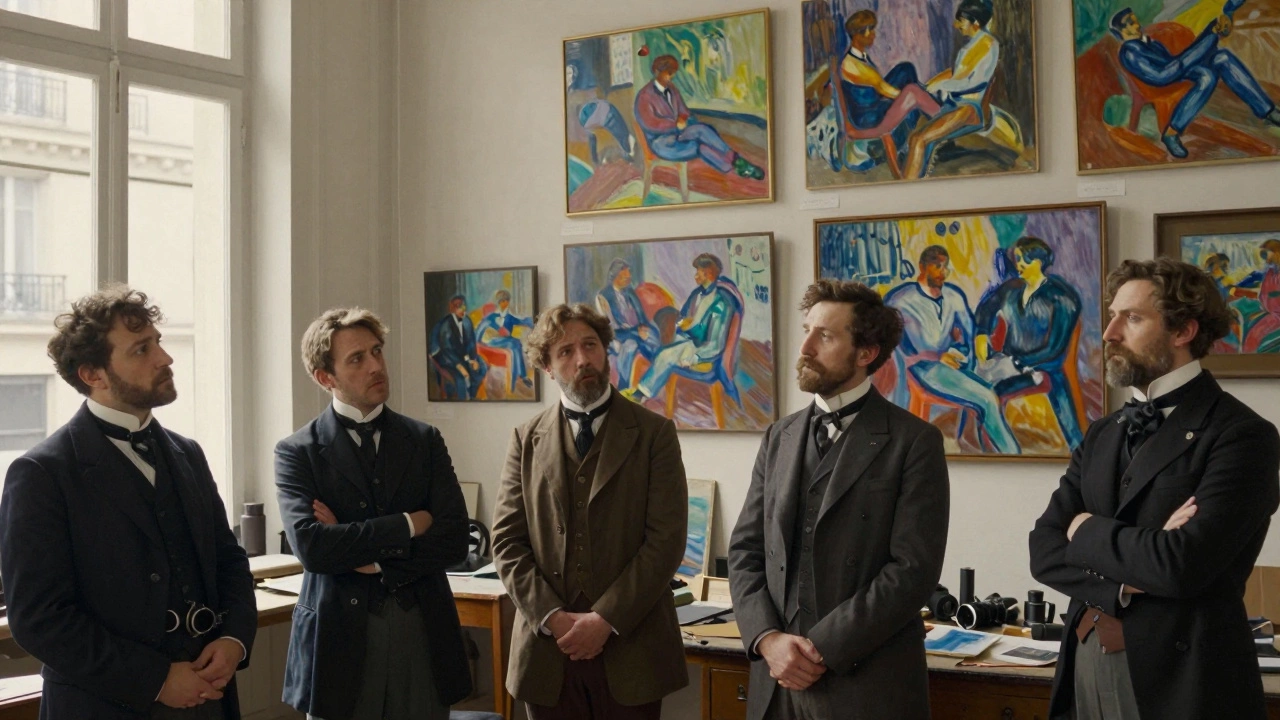
Picture this: It is 1874. A group of painters rents a photographer’s studio in Paris because the official Salon rejected their work. They hang their paintings side by side with no labels. Critics walk in, expecting polished landscapes and heroic historical scenes. Instead, they see blurry figures, bright colors that look unfinished, and everyday people doing nothing special. One critic mocks them, calling them "impressionists" because one painting looks like a mere impression of light. That insult sticks. But it also marks the moment everything changed.
That rebellion wasn't just about bad manners. It was the spark that ignited modern art, a radical shift away from realistic representation toward personal expression, abstraction, and new materials. To understand what started modern art, you have to look beyond the canvas. You have to look at the factories, the cameras, and the shattered empires of the late 19th century.
The Camera Killed the Portrait (And Saved the Artist)
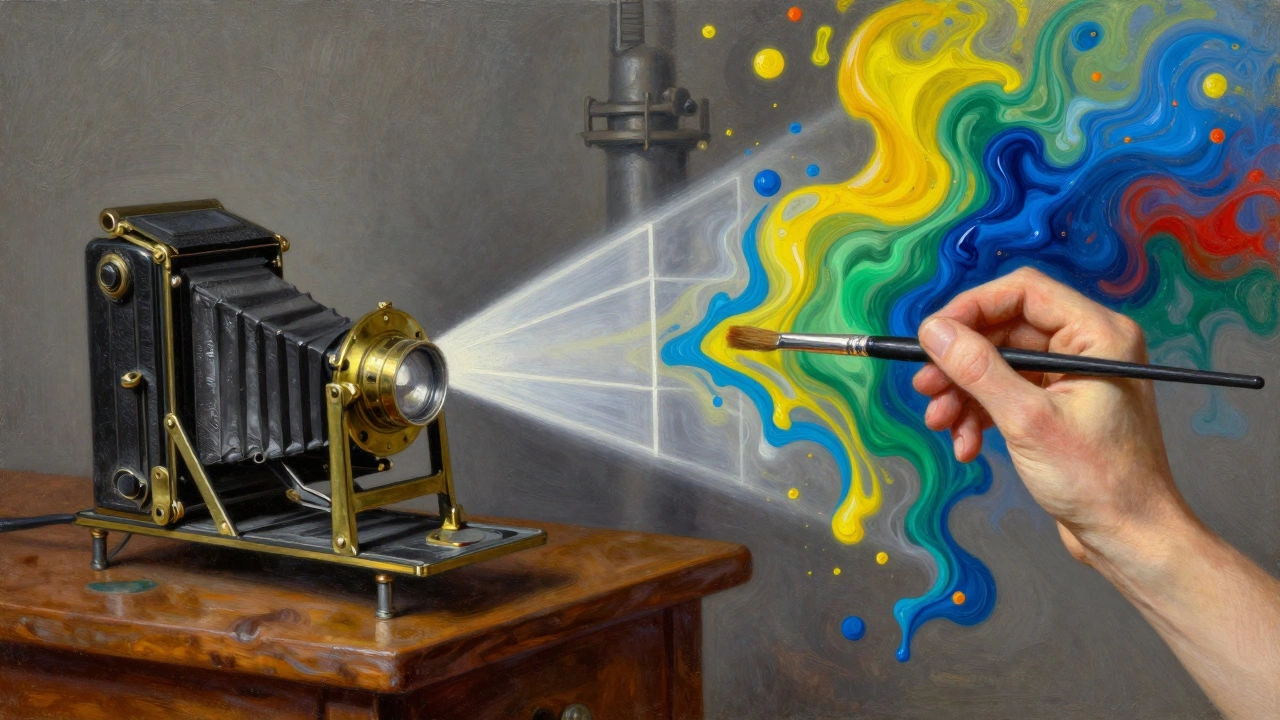
For centuries, the main job of a painter was to record reality. If you wanted your likeness preserved, or if you wanted to document a battle, you hired an artist. Paintings were documents. Then, in 1839, Louis Daguerre unveiled the daguerreotype. Suddenly, a machine could capture a scene with perfect accuracy in minutes. Why pay a master painter three months to sit for a portrait when a camera could do it instantly?
This technological shock forced artists to ask a terrifying question: What is left for us to do? If the machine can copy the world, what is the human eye good for? Artists realized they couldn't compete on realism. So they stopped trying. Instead of copying the object, they began to paint the experience of seeing it. This pivot is the foundation of modernism. It shifted the focus from *what* was being painted to *how* it was being perceived.
Claude Monet didn't care if his haystack looked exactly like a haystack. He cared about how the light hit the hay at four o'clock versus five o'clock. This obsession with perception over replication opened the door for every movement that followed. It liberated the brushstroke. It allowed color to exist independently of form.
Industrialization and the Urban Experience
You cannot separate modern art from the steam engine. The Industrial Revolution didn't just change how we made things; it changed how we saw the world. Cities exploded in size. Paris grew from a medieval town into a sprawling metropolis under Baron Haussmann’s renovations. Wide boulevards replaced narrow alleys. Gas lamps pushed back the night. Trains moved people faster than horses ever could.
This new urban environment created a sense of speed, fragmentation, and alienation. Artists felt overwhelmed by the sheer volume of visual information. Édouard Manet captured this in works like Le Déjeuner sur l'herbe, where figures stare out at the viewer with a blank, modern detachment. There is no story, no myth, just a awkward, contemporary moment frozen in time.
The chaos of the city influenced composition too. Japanese woodblock prints, which flooded Europe after Japan opened its ports in the 1850s, offered a different way of organizing space. These prints used flat areas of color, cropped perspectives, and asymmetrical layouts. Vincent van Gogh and Edgar Degas studied these prints closely. They abandoned the traditional pyramid composition for something more dynamic and jagged. The world was breaking apart, and art had to reflect that fracture.
From Impressionism to the Inner World
If Impressionism was about the eye, Post-Impressionism was about the mind. By the 1880s, artists like Paul Cézanne, Georges Seurat, and Van Gogh found Impressionism too fleeting. They wanted structure. They wanted emotion. They wanted truth.
Cézanne tried to treat nature according to the cylinder, the sphere, and the cone. He broke objects down into geometric shapes, paving the way for Cubism. Van Gogh used swirling, violent brushstrokes to convey his mental anguish. Seurat used tiny dots of pure color (Pointillism) to create optical mixing, treating painting like a scientific experiment. Each of these men took the freedom granted by Impressionism and twisted it toward a new goal: expressing inner states rather than outer appearances.
This turn inward was crucial. It meant that art no longer needed to be recognizable to be valid. If a painting could make you feel sadness, joy, or confusion through color and line alone, it succeeded. This idea would explode in the 20th century with Abstract Expressionism, but the seed was planted here.
The Shock of the New: Fauvism and Cubism
By 1900, the groundwork was laid. The next generation of artists didn't just want to refine tradition; they wanted to destroy it. In 1905, Henri Matisse and André Derain went to the coast of France and painted with wild, non-naturalistic colors. Red skies, green faces, blue trees. Critics called them "les fauves" (wild beasts). Fauvism proved that color could carry emotional weight independent of description.
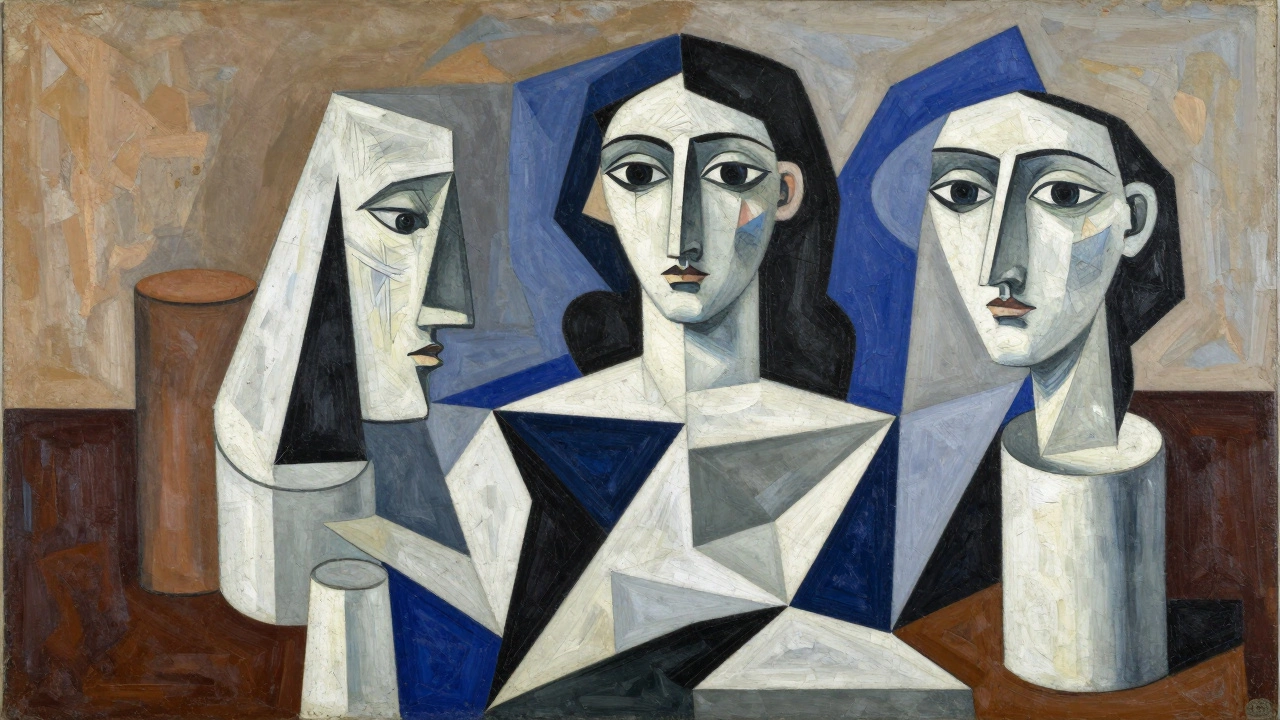
Then came Pablo Picasso and Georges Braque. Inspired by Cézanne’s geometry and African masks they saw in ethnographic museums, they invented Cubism around 1907. Instead of showing an object from one angle, they showed it from all angles at once. A face might have a profile nose and frontal eyes. Time and space collapsed. This was not just a style change; it was a philosophical statement. Reality is not fixed. It is relative. This aligned perfectly with Albert Einstein’s theory of relativity, published just a few years later.
| Movement | Time Period | Key Innovation | Representative Artist |
|---|---|---|---|
| Impressionism | 1860s-1880s | Captured light and fleeting moments | Claude Monet |
| Post-Impressionism | 1880s-1900s | Emotional expression and structural form | Vincent van Gogh |
| Fauvism | 1904-1908 | Wild, non-naturalistic color | Henri Matisse |
| Cubism | 1907-1914 | Fragmented, multi-perspective views | Pablo Picasso |
War, Trauma, and the Absurd
World War I shattered the illusion of progress. The industrial efficiency that built cities now killed millions in trenches. The rational, ordered world of the 19th century seemed like a lie. Artists responded with movements that embraced chaos and irrationality.
Dada, born in Zurich in 1916, was an anti-art movement. It used nonsense, randomness, and trash to mock the logic that led to war. Marcel Duchamp took a urinal, signed it, and called it Fountain. He asked: If I say it is art, is it art? This challenged the very definition of creativity. Surrealism, led by André Breton, explored the unconscious mind, drawing from Sigmund Freud’s psychoanalysis. Dreams, nightmares, and automatic writing became tools for creation.
These movements stripped art of its beauty and purpose. Art became a tool for critique, therapy, and philosophical inquiry. It was no longer about decorating salons; it was about confronting the darkness of the human condition.
Why It Matters Today
Understanding what started modern art helps us make sense of today’s galleries. When you see a blank white canvas by Robert Rauschenberg or a neon sign by Dan Flavin, you are seeing the direct descendants of that 1874 rebellion. The rulebook was thrown out. Anything goes. Any material, any concept, any medium is fair game.
Modern art taught us that art is not a mirror reflecting the world, but a hammer shaping it. It gave artists the permission to fail, to experiment, and to prioritize their unique vision over public approval. That legacy continues to drive innovation in digital art, installation, and performance today.
When did modern art start?
Most art historians pinpoint the start of modern art to the 1860s and 1870s, specifically with the emergence of Impressionism in Paris. The first Impressionist exhibition in 1874 is often cited as the definitive starting point.
Who is considered the father of modern art?
Paul Cézanne is frequently called the "father of modern art." His approach to breaking down forms into geometric shapes directly influenced Cubism and paved the way for abstract art. However, Édouard Manet is also credited as a pioneer for breaking with academic traditions earlier in the century.
What is the difference between modern and contemporary art?
Modern art generally refers to the period from the 1860s to the 1970s. Contemporary art refers to art produced from the late 20th century to the present day. While modern art focused on breaking rules and abstraction, contemporary art often engages with global issues, identity, and new technologies.
Did photography cause the rise of modern art?
Yes, largely. The invention of photography freed painters from the obligation to create realistic representations. This allowed them to explore color, light, and emotion in ways that were previously impossible, leading directly to Impressionism and subsequent modern movements.
Why is modern art so abstract?
Modern art became abstract because artists sought to express internal truths, emotions, and concepts rather than external realities. Influenced by psychology, philosophy, and the trauma of war, they believed that figurative art limited their ability to communicate complex human experiences.