Broadway Show Longevity Calculator
Compare Broadway Show Longevity
Compare the performance history of the world's longest-running Broadway musicals to see how The Phantom of the Opera compares to other record-holding shows.
Compare two shows to see how their longevity stacks up.
When people ask what the #1 Broadway show of all time is, they’re not just asking about popularity or ticket sales. They’re asking which show left the deepest mark on theater history - the one that kept audiences coming back for decades, changed how musicals were made, and became a cultural landmark. The answer isn’t close. Broadway’s #1 show of all time is The Phantom of the Opera.
It’s not just the longest-running show on Broadway - it’s the longest-running show in the history of any theater in the world. Opened on January 26, 1988, at the Majestic Theatre, it ran for 34 years. That’s 13,981 performances before it closed on April 16, 2023. No other musical comes close. Les Misérables ran for 6,680 shows. Cats held on for 7,485. The Phantom of the Opera more than doubled both. It wasn’t just a hit. It was a phenomenon.
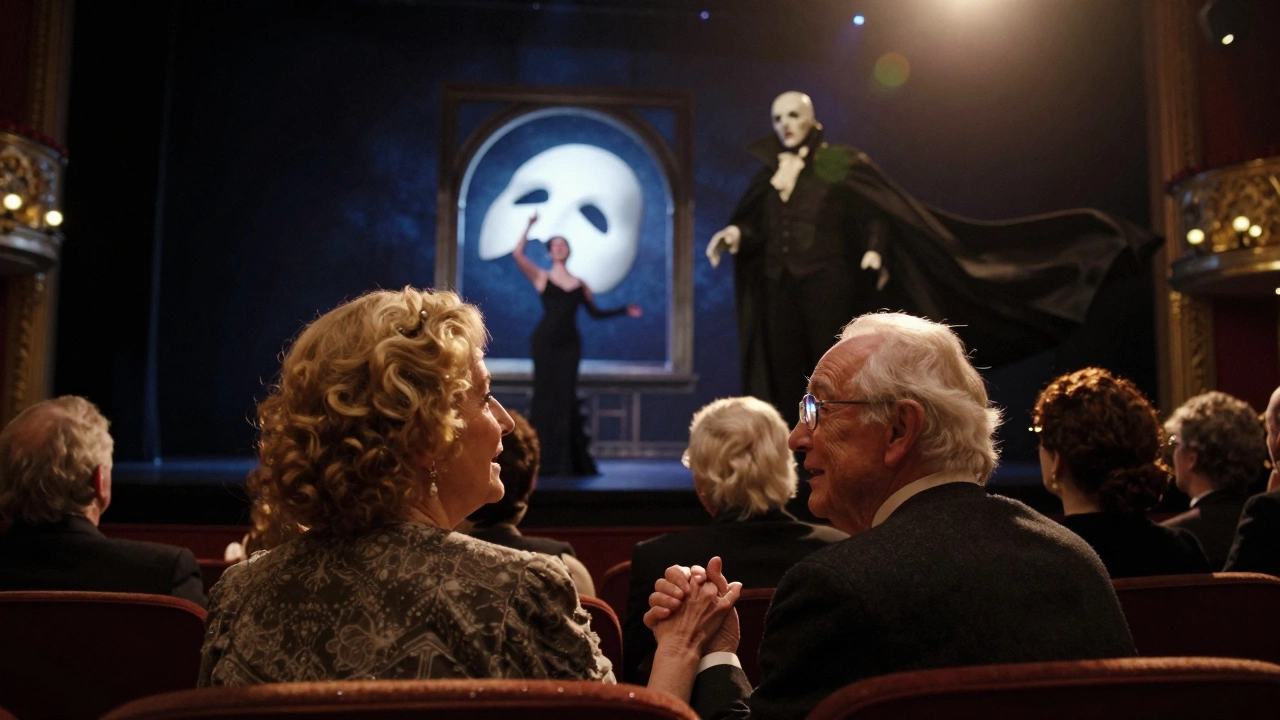
Why did it last so long? Partly because it wasn’t just a musical - it was an experience. The chandelier that dropped from the ceiling. The ghostly organ music echoing through the theater. The masked figure gliding across the stage on wires. These weren’t just special effects. They were moments people talked about for years. Parents brought their kids. Grandparents took their grandchildren. People saw it five, ten, even twenty times. It became a rite of passage.
Andrew Lloyd Webber’s score didn’t hurt. Songs like "The Music of the Night," "All I Ask of You," and the title track became standards. They were played on radio, covered by pop singers, and used in commercials. You didn’t have to love theater to know those melodies. They seeped into popular culture. Even people who’d never set foot in a theater could hum the opening notes.
And then there’s the story. A haunting romance between a gifted singer and a disfigured genius living beneath the opera house. It had tragedy, obsession, beauty, and terror - all wrapped in velvet curtains and chandeliers. It was Shakespearean in scale, but told with modern musical tools. Unlike many shows that rely on flashy dance numbers or pop songs, The Phantom of the Opera leaned into opera itself. The lead tenor had to sing like a classical performer. The soprano had to hit notes that made people hold their breath. It demanded skill, not just energy.
Its success wasn’t accidental. The production design alone cost more than $10 million in 1988 - a record at the time. The costumes were hand-sewn. The chandelier weighed over a ton. The set moved on hydraulic lifts. Every detail was built to last. The show didn’t just tour - it was engineered to be seen again and again, in every city, every country. It opened in London in 1986. By 2023, it had been performed in over 30 countries, translated into 10 languages, and seen by more than 145 million people worldwide.
Some argue Les Misérables is more emotionally powerful. Others say Hamilton changed the game with its hip-hop rhythms and diverse casting. But power and innovation don’t always equal longevity. Les Misérables ran for 16 years on Broadway. Hamilton is still going strong, but it’s only been around since 2016. The Phantom of the Opera didn’t just survive trends - it defined them. It was the show that made Broadway a global brand.
Even after it closed, its legacy didn’t fade. The original Broadway cast album sold over 3 million copies. It’s still the best-selling cast album in history. The soundtrack is on Spotify, Apple Music, and YouTube - millions of streams every month. People still dress up for the opening night. The iconic mask is sold in gift shops across New York. It’s not just a show. It’s a symbol.
What about other contenders? Cats had the dancing cats and the famous "Memory" song. But it didn’t have the emotional weight. Chicago had style and sass. Wicked had a modern fanbase. But none of them matched the scale, the consistency, or the sheer number of people who came back - again and again.
There’s a reason The Phantom of the Opera still holds the record. It wasn’t just good. It was unforgettable. It made theater feel like magic. And for 34 years, it delivered that magic - night after night, without fail.
How The Phantom of the Opera Changed Broadway
Before The Phantom of the Opera, Broadway shows were often seen as niche entertainment. Tourists might catch one during a trip to New York, but it wasn’t a global obsession. After it opened, everything changed.
Producers started investing more in spectacle. The show proved that audiences would pay premium prices - sometimes over $100 a ticket - for a visually stunning experience. It opened the door for shows like Spider-Man: Turn Off the Dark and Harry Potter and the Cursed Child, which pushed the limits of stage technology. But none of those had the staying power.
It also changed how musicals were marketed. The Phantom of the Opera was one of the first shows to use international touring as a core strategy. It wasn’t just a New York show - it was a worldwide brand. The original London production ran for 35 years. The German version still plays in Essen. The Japanese version has been running since 1997. It became a cultural export, like Coca-Cola or McDonald’s.
Even the way tickets were sold shifted. Before The Phantom of the Opera, most shows sold tickets at the box office. Afterward, ticketing agencies like Ticketmaster became essential. Demand was so high that resale markets exploded. People paid thousands for seats. It turned Broadway into a high-stakes business - not just an art form.
Why It Still Matters Today
Even though it closed in 2023, The Phantom of the Opera didn’t disappear. Its influence is everywhere.
Modern musicals still borrow its structure: a central romance, a mysterious villain, a grand set piece, and a soaring ballad. The way it blended classical music with pop sensibilities became the blueprint for shows like Dear Evan Hansen and Hadestown.
And let’s not forget the young performers who grew up listening to its soundtrack. Many of today’s Broadway stars say they got into theater because of The Phantom of the Opera. It inspired a generation.
When you walk into a modern Broadway theater, you still see echoes of it - the dimmed lights, the slow build of the overture, the moment the chandelier drops. That’s not coincidence. That’s legacy.
Comparison: Top Longest-Running Broadway Musicals
| Show | Opening Year | Performances | Closure Year | Key Feature |
|---|---|---|---|---|
| The Phantom of the Opera | 1988 | 13,981 | 2023 | Chandelier drop, gothic romance |
| Les Misérables | 1987 | 6,680 | 2003 | Revolutionary story, powerful ballads |
| Cats | 1982 | 7,485 | 2000 | Cat costumes, "Memory" song |
| The Lion King | 1997 | 9,873 | 2026 | Puppetry, African-inspired visuals |
| Chicago | 1996 | 9,578 | 2024 | Jazz, satire, dance numbers |
Why Other Shows Didn’t Top It
Some might argue that Hamilton is more important culturally. And it is - it redefined what a Broadway musical could sound like. But importance and longevity aren’t the same thing. Hamilton has been running for less than a decade. The Phantom of the Opera ran for over three decades. It didn’t just appeal to one generation - it spanned four.
And while Wicked has a passionate fanbase, it still hasn’t passed Cats in performance count. Jersey Boys and Abba Voyage had their moments, but they lacked the epic scale.
There’s a reason The Phantom of the Opera is still the record holder. It didn’t just entertain. It transported. It made people believe in ghosts, in love, in music that could move mountains.
Is The Phantom of the Opera still playing on Broadway?
No. The Phantom of the Opera closed on April 16, 2023, after 34 years and 13,981 performances. It holds the record as the longest-running show in Broadway history. While it no longer runs in New York, it continues to be performed in cities around the world, including London, Tokyo, and Sydney.
What makes The Phantom of the Opera different from other Broadway shows?
It combined gothic storytelling, classical opera-style singing, and groundbreaking stage technology. The chandelier, the underground lair, and the masked figure were unlike anything seen before. It wasn’t just a musical - it was a theatrical experience designed to be unforgettable. No other show matched its blend of spectacle, emotion, and musical depth.
Did The Phantom of the Opera win any Tony Awards?
Yes. It won seven Tony Awards in 1988, including Best Musical, Best Actor (Michael Crawford), and Best Scenic Design. It was also nominated for Best Costume Design and Best Direction. Its awards helped cement its status as a landmark production.
How many people have seen The Phantom of the Opera worldwide?
More than 145 million people have seen The Phantom of the Opera across 30+ countries since its 1986 London premiere. It’s the most-watched musical in history.
Is The Phantom of the Opera the best-selling cast album of all time?
Yes. The original Broadway cast recording has sold over 3 million copies in the U.S. alone and more than 40 million worldwide. It remains the best-selling cast album in history, according to the Recording Industry Association of America (RIAA).
What Comes Next?
The curtain may have closed on The Phantom of the Opera, but its story isn’t over. New generations are discovering it through recordings, streaming, and school performances. It’s taught in music classes. It’s performed by high school drama clubs. It’s still the show that teaches kids what theater can be.
Maybe one day, another show will break its record. But for now, The Phantom of the Opera stands alone - not just as the #1 Broadway show of all time, but as the one that made theater unforgettable.