Rule of Thirds Grid Calculator
Calculate and visualize the rule of thirds grid for your oil painting canvas. This tool shows you where to place key elements for optimal composition.
Visual Composition Guide
Pro Tip
Place your main subject near one of the four power points. For landscapes, position the horizon line on the top or bottom third line. Remember: the rule of thirds creates visual flow and balance.
Ever look at an oil painting and feel like it just works-even if you can’t explain why? Chances are, the artist used the rule of thirds. It’s not magic. It’s a simple grid that helps you place elements where the eye naturally wants to go. And in oil painting, where depth and texture can overwhelm a canvas, this rule becomes your quiet ally.
What Exactly Is the Rule of Thirds?
The rule of thirds is a grid that splits your canvas into nine equal parts. Imagine two horizontal lines and two vertical lines drawn across your painting surface. These lines divide the space into thirds, both vertically and horizontally. The four points where these lines cross are called power points. These are your visual sweet spots.
This isn’t some modern invention. Artists have used variations of this for centuries. In the 18th century, John Thomas Smith, an English artist and engraver, wrote about dividing a canvas into thirds to create balance. He didn’t call it the rule of thirds, but he described exactly how it works. By the 20th century, photographers and painters alike adopted it as a standard tool.
Why does it matter in oil painting? Because oil paint builds up slowly. You can’t just snap a photo and adjust the crop later. You’re working with layers, glazes, and textures that take days to dry. If you place your main subject dead center, your painting can feel flat, stiff, or boring. The rule of thirds gives you a structure to guide the viewer’s eye without forcing it.
How to Apply It to Your Oil Paintings
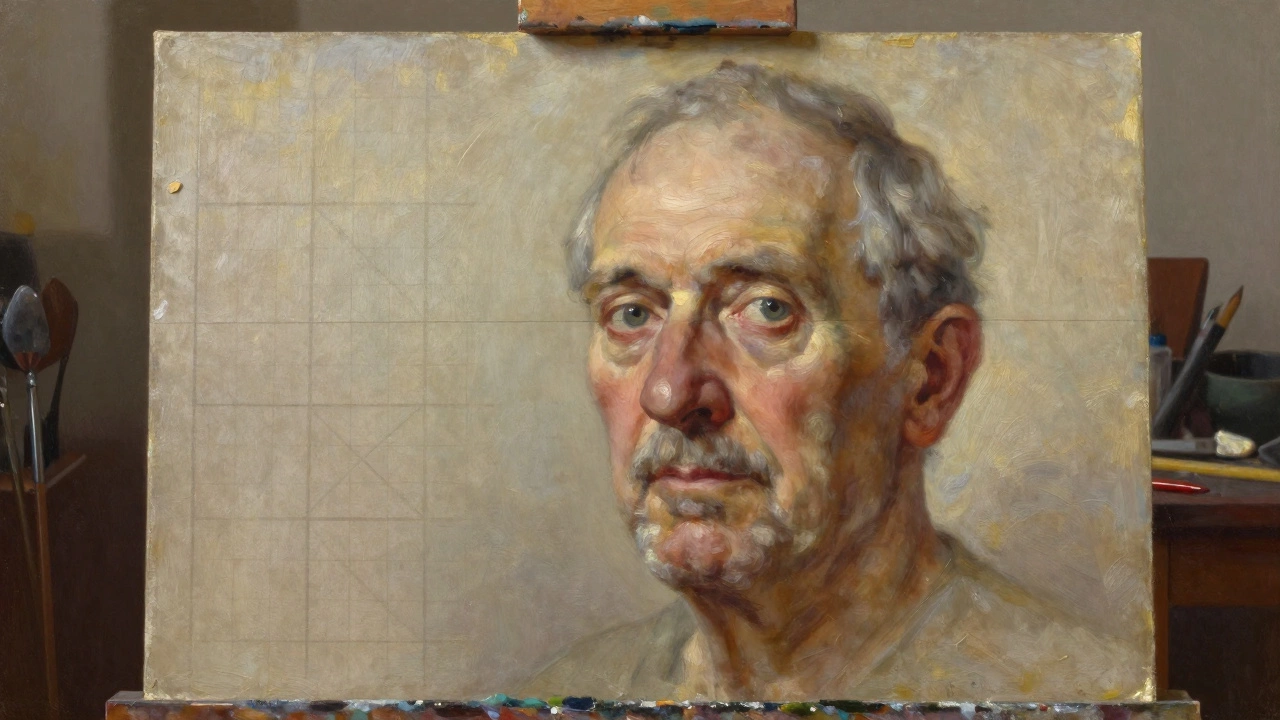
Start by sketching your composition lightly with a pencil or thin brush. Don’t draw the full grid-just mark the four power points. Then ask yourself:
- Where does the main subject belong? A face, a tree, a boat? Place it near one of those crossing points.
- Where should the horizon line go? If you’re painting a landscape, don’t put it in the middle. Put it on the top third for more sky, or the bottom third for more land.
- What about secondary elements? A path, a fence, a river? Let them follow one of the vertical or horizontal lines.
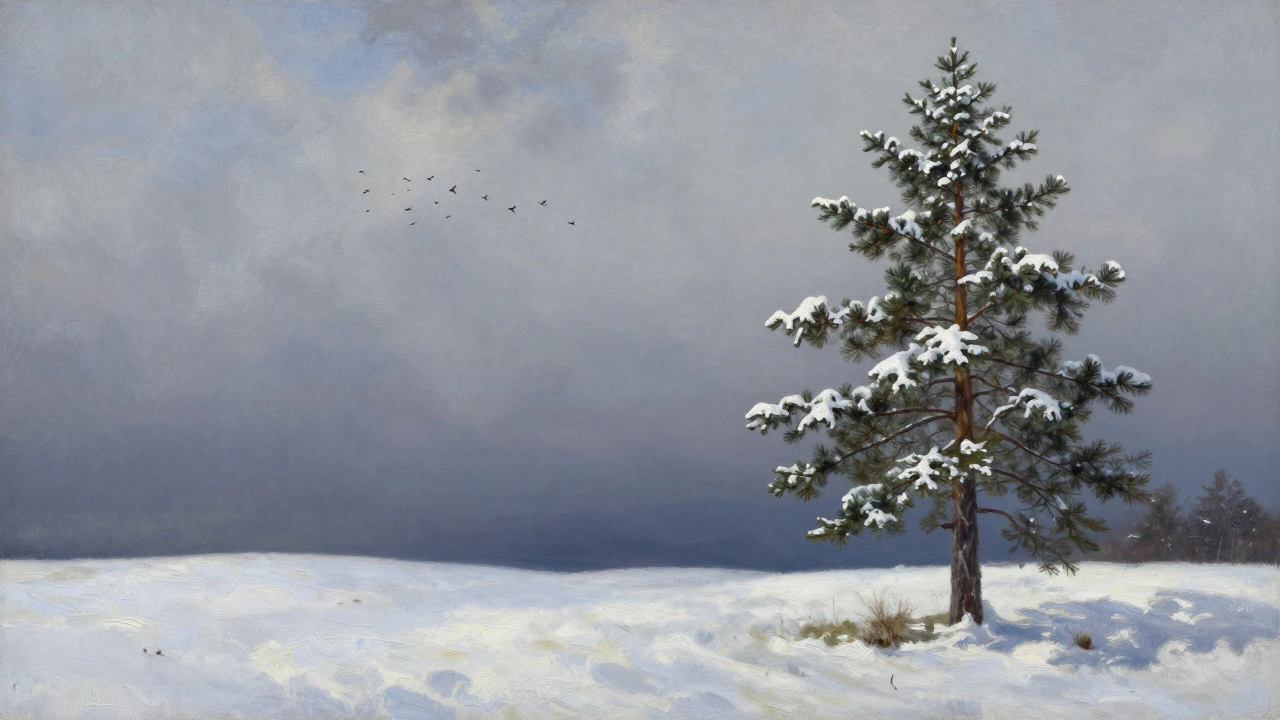
Here’s a real example: In a landscape I painted last winter near Squamish, I wanted to show a lone pine tree against a snowy mountain. I placed the tree on the right vertical line, about one-third up from the bottom. The horizon sat on the lower third line, giving the sky two-thirds of the canvas. The snow-laden branches pointed toward the top-left power point, where a faint flock of birds flew. The painting felt alive-not because of color, but because of where things were placed.
Why It Works Better Than Centered Composition
Centered subjects are safe. But safety in art often means dullness. When you put the focal point dead center, your viewer’s eye lands there and stops. There’s no journey. No tension. No story.
The rule of thirds creates movement. It lets the eye wander. It sets up a visual rhythm. If your subject is on the left third, your viewer’s eye naturally moves right-past a stream, a shadow, a patch of light-until it finds something else to rest on. That’s called visual flow. And in oil painting, where you can control every brushstroke, you can guide that flow intentionally.
Think of it like a conversation. If you say everything in one breath, people tune out. But if you pause, shift tone, let silence breathe-you hold attention. The rule of thirds is that pause.
When to Break the Rule
Rules exist to be understood, not followed blindly. Some of the most powerful oil paintings break the rule of thirds. A symmetrical portrait, a centered cathedral, a lone figure in the middle of an empty room-these can be hauntingly effective.
But here’s the key: you only break the rule when you know it well enough to break it on purpose. If you don’t understand why the rule works, then centering your subject isn’t a bold choice-it’s a mistake.
Take Rembrandt’s Self-Portrait with Two Circles. The figure isn’t centered. His eyes sit near the upper-right power point. The two circles behind him? One touches the top horizontal line. The other aligns with the right vertical. He used the rule to create tension between symmetry and imbalance. That’s mastery.
Common Mistakes Beginners Make
Even when artists know the rule, they still mess it up. Here are the three most common errors:
- Using the grid too rigidly. Your subject doesn’t need to sit exactly on the intersection. Being within 10% of it is fine. Oil painting is about feel, not measurement.
- Ignoring negative space. The rule isn’t just about where to put things-it’s also about where to leave empty space. A large area of sky or water on one side can balance a small figure on the other.
- Forgetting the background. The rule applies to everything. A tree, a house, a cloud-they all need placement. If your background is chaotic, even a perfect subject will get lost.
One student I taught last year kept placing her sunsets dead center. She thought it made them look "more dramatic." But the result was flat. Once she moved the horizon to the lower third and shifted the sun to the right power point, the painting suddenly had depth. The clouds started to feel like they were moving. The water reflected light differently. It was like the whole scene breathed.
Tools to Help You Practice
You don’t need fancy gear. But a few simple tools make this easier:
- Grid overlay on your canvas. Use masking tape to lightly mark the thirds on your stretcher bars. Or draw faint lines with a pencil and erasable ruler.
- Your phone camera. Turn on the grid feature in your camera app. Take photos of your setup. See where the elements land. It’s instant feedback.
- Study the masters. Look at oil paintings by J.M.W. Turner, Edward Hopper, or Andrew Wyeth. Zoom in. Where are the key elements placed? You’ll see the rule again and again-even if the artist never named it.
One exercise I do every few months: I pick a famous oil painting and redraw it using only the rule of thirds grid. No details. Just lines and shapes. It teaches you how composition holds the whole thing together-even without color or texture.
Final Thought: It’s Not About Perfection
The rule of thirds isn’t a law. It’s a suggestion. A compass. A way to avoid the traps of instinct.
Oil painting is slow. It’s messy. It’s emotional. You’ll spend hours blending a sky, scraping back a hillside, glazing a shadow. The rule of thirds won’t make those decisions for you. But it will give you a quiet framework so you don’t lose your way.
Next time you start a new piece, sketch the grid. Don’t overthink it. Just place your subject near one of those crossing points. Step back. Look. Does it feel right? If yes, keep going. If not, shift it. That’s the real skill-not following the rule, but learning to listen to your own eye.
Is the rule of thirds only for landscapes in oil painting?
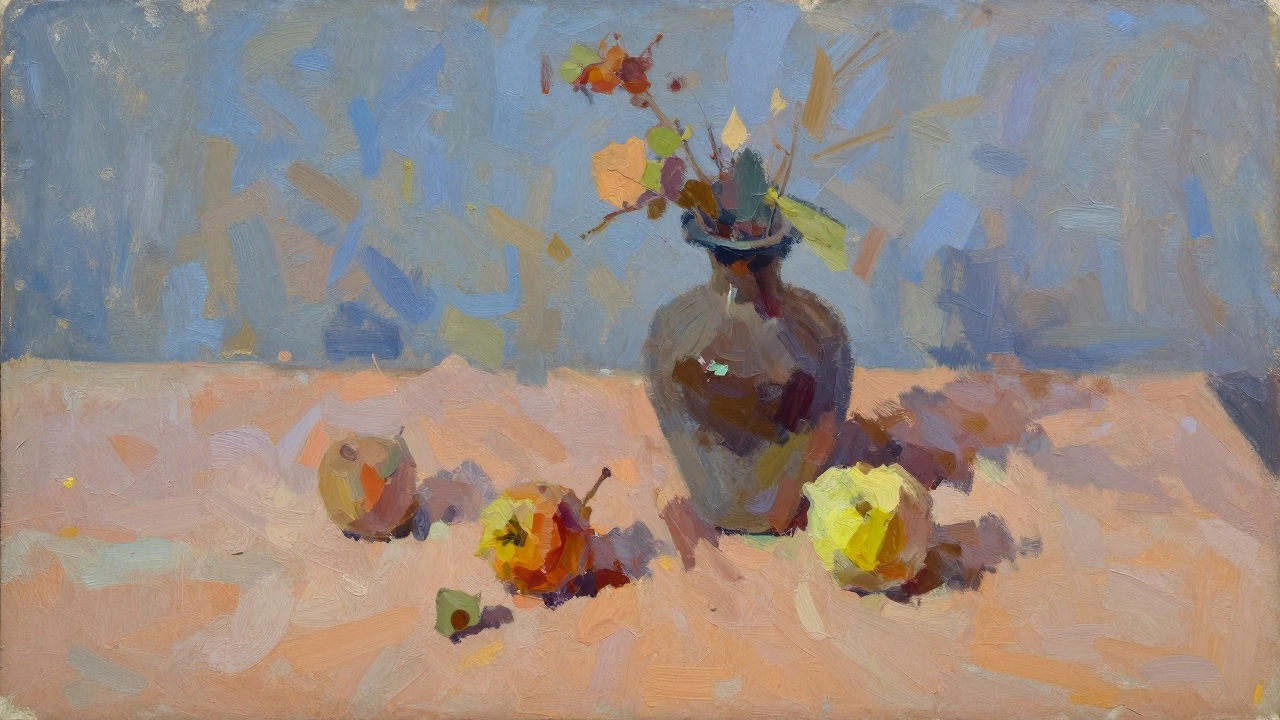
No. The rule of thirds works for every type of oil painting-portraits, still lifes, abstracts, and even interiors. In a portrait, placing the eyes near the upper horizontal line creates a natural focal point. In a still life, putting the main object on a power point adds balance to cluttered arrangements. Even in abstract work, using the grid helps distribute visual weight so the painting doesn’t feel lopsided.
Do professional oil painters always use the rule of thirds?
Not always, but most use it at least as a starting point. Even artists who seem to break all the rules-like Francis Bacon or Willem de Kooning-often begin with a grid. They shift, distort, or ignore it later, but the foundation is still there. It’s like learning grammar before writing poetry. You need to know the structure before you can bend it.
Can I use the rule of thirds with a square canvas?
Yes. The rule works on any shape. On a square canvas, divide each side into thirds and draw the same grid. The power points still guide placement. Many modern oil painters use square formats for portraits or abstract compositions, and the rule still helps them avoid centering everything. It’s about balance, not rectangle shape.
How is the rule of thirds different from the golden ratio?
The golden ratio uses a spiral or a 1:1.618 proportion, which is more complex. The rule of thirds is simpler: 1/3 and 2/3 divisions. Most artists use the rule of thirds because it’s easier to eyeball and faster to apply. The golden ratio is mathematically precise but harder to use with paint. The rule of thirds gives you 80% of the benefit with 20% of the effort.
Should I draw the grid before I start painting?
Not necessarily. Many artists sketch the grid lightly in pencil and erase it later. Others use a digital grid on their tablet or phone to check composition before transferring to canvas. Some don’t use a grid at all-they just train their eye over time. The goal isn’t to have perfect lines; it’s to develop an instinct for placement. Start with the grid. Eventually, you’ll feel it without drawing it.