Art Movement Comparison Tool
How Modern and Traditional Art Differ
Select a category below to see how modern and traditional art contrast in this specific area. Toggle each comparison to highlight your focus.
Category Selection
Traditional Art
Technique: Precision vs Experimentation
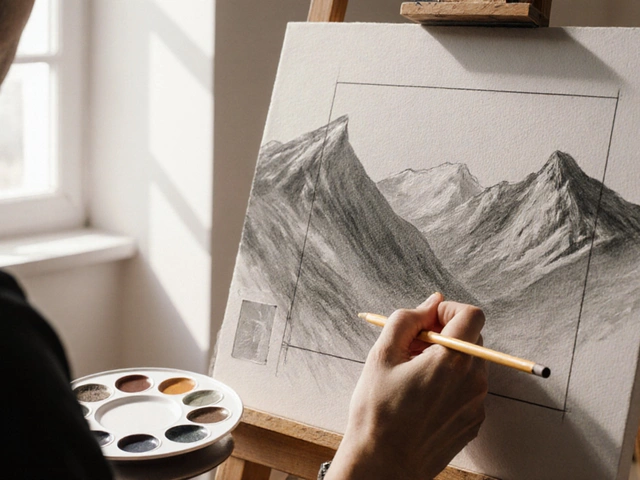
Traditional artists used oil paints, tempera, and gold leaf with meticulous care. They built layers over weeks. Every stroke was planned. Shadows were blended. Skin tones were mixed from multiple pigments. The result? A polished, lifelike surface.
Modern Art
Technique: Precision vs Experimentation
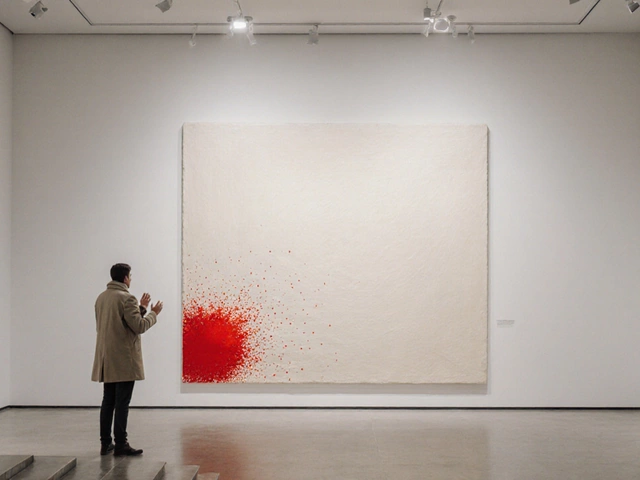
Modern artists threw out the playbook. They used house paint, sand, newspaper, and even industrial materials. Jackson Pollock flung paint onto a canvas on the floor. Yves Klein used human bodies as brushes. Technique wasn't about skill—it was about expression.
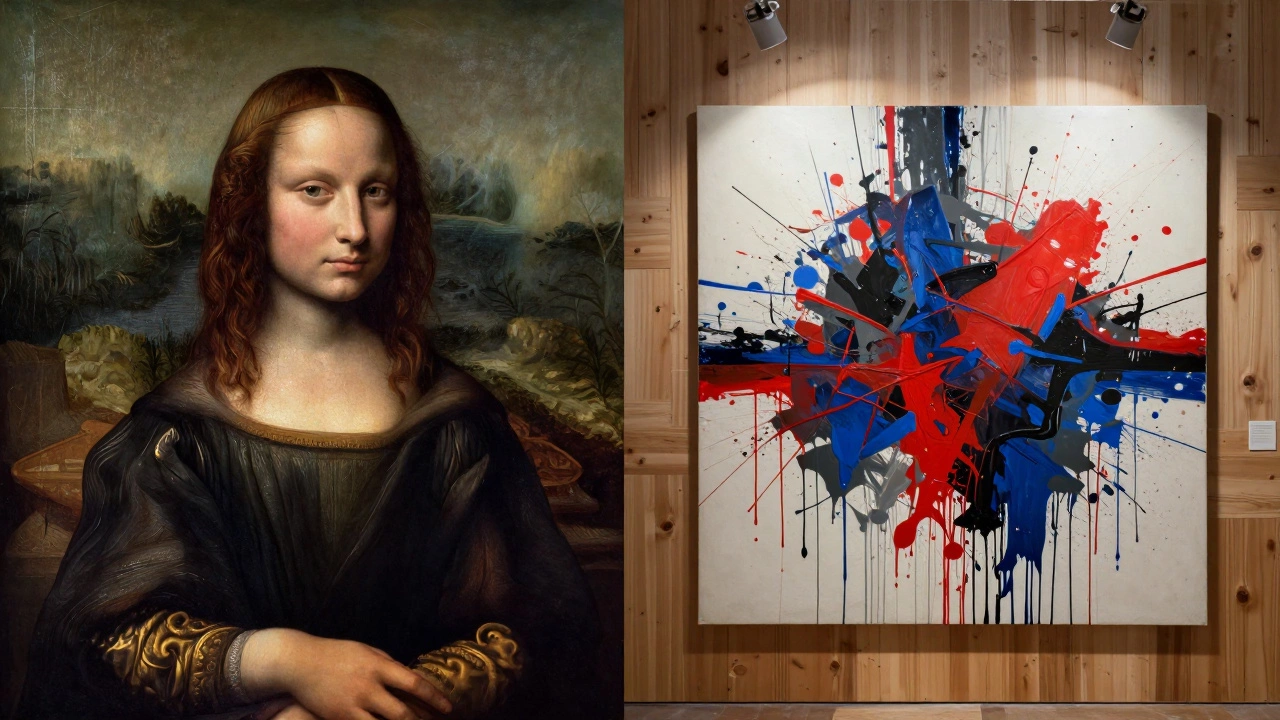
When you walk into a museum, you might see a Renaissance painting of a serene Madonna next to a canvas splattered with random brushstrokes and drips of paint. It’s easy to wonder: what is the difference between modern art and traditional art? The answer isn’t just about style-it’s about mindset, purpose, and how artists saw the world around them.
Traditional Art: Rules, Realism, and Ritual
Traditional art, as practiced from the Renaissance through the late 1800s, was built on a clear set of rules. Artists trained for years to master perspective, anatomy, and light. Their goal? To make the world look real. A portrait wasn’t just a face-it was a statement of status, power, or piety. Landscapes were carefully composed to show harmony between humans and nature. Even religious scenes followed strict iconography-every gesture, color, and object had meaning.
Think of works like Leonardo da Vinci’s Mona Lisa or Jean-Auguste-Dominique Ingres’s La Grande Odalisque. These pieces took months, sometimes years, to complete. Brushes were fine. Pigments were ground by hand. The artist’s job was to obey nature, not break from it. Art was often commissioned-by churches, kings, or wealthy families-and had to serve a purpose: to honor, to teach, or to display wealth.
Modern Art: Breaking the Rules
Modern art began around the 1860s and lasted until the 1970s. It didn’t just evolve-it exploded. Artists started rejecting centuries of tradition. Why paint a perfect landscape when photography could do it better? Why follow rigid rules when the world was changing faster than ever?
Industrialization, urban life, new scientific ideas, and even wars reshaped how people saw reality. Artists responded. Impressionists like Monet painted light as it changed, not as it "should" look. Van Gogh twisted his brushstrokes to show emotion, not anatomy. Picasso shattered faces into geometric shapes. Duchamp put a urinal in a gallery and called it art.
Modern art didn’t care about technical perfection. It cared about ideas. A painting didn’t need to look real to be powerful. In fact, the more it broke from reality, the more it forced you to think. The brushstroke became a voice. Color became emotion. Form became rebellion.
Technique: Precision vs. Experimentation
Traditional artists used oil paints, tempera, and gold leaf with meticulous care. They built layers over weeks. Every stroke was planned. Shadows were blended. Skin tones were mixed from multiple pigments. The result? A polished, lifelike surface.
Modern artists threw out the playbook. They used house paint, sand, newspaper, and even industrial materials. Jackson Pollock flung paint onto a canvas on the floor. Yves Klein used human bodies as brushes. Mark Rothko stacked layers of thin color to create emotional fields. Technique wasn’t about skill-it was about expression.
One famous example: Edouard Manet’s Olympia (1863). A nude woman stared directly at the viewer-not in idealized beauty, but with cold, unapologetic realism. The painting shocked Paris. Why? Because it broke every rule of how a woman should be portrayed in art. That moment marked the beginning of modern art’s shift from decoration to confrontation.
Purpose: Beauty vs. Questioning
Traditional art often aimed to please. To inspire awe. To reinforce social order. It was about harmony, balance, and timeless ideals.
Modern art asked questions. Who are we? What is truth? Is beauty even real? Artists didn’t want to comfort you-they wanted to unsettle you. A sculpture by Constantin Brâncuși wasn’t meant to look like a bird. It was meant to make you feel flight. A collage by Hannah Höch wasn’t a pretty picture-it was a critique of gender and media.
Traditional art said: "Look at this beautiful thing." Modern art said: "Why do you think that’s beautiful?"
Materials and Tools: From Natural to Industrial
Traditional artists worked with natural materials: animal-hide canvases, mineral-based pigments, handmade brushes. Their tools were slow, expensive, and required deep knowledge.
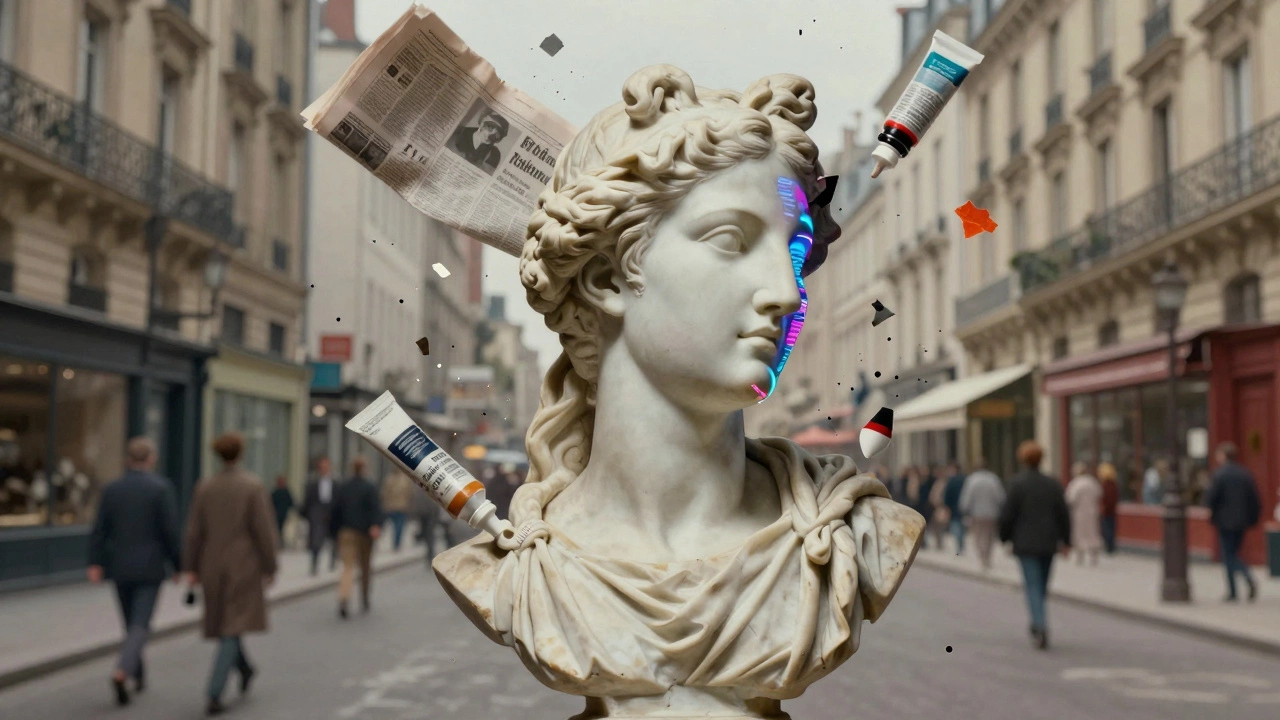
Modern artists embraced the new. Synthetic paints became available in tubes in the 1840s, letting artists paint outdoors. Aluminum, metal, plastic, and even neon lights entered studios. Marcel Duchamp’s Fountain (1917)-a porcelain urinal-wasn’t made by hand. It was mass-produced. And that was the point: art didn’t need to be handmade to be meaningful.
By the 1950s, artists were using spray cans, industrial adhesives, and found objects. The studio became a workshop. The artist became an assemblage artist, a performance artist, a conceptual thinker. The medium wasn’t just a tool-it was part of the message.
Who Was It For?
Traditional art was made for a small, elite audience: royalty, clergy, the wealthy. It lived in palaces, cathedrals, and private collections. Access was limited. Understanding was often guided by tradition or religious doctrine.
Modern art, especially after World War II, became public. Museums opened to everyone. Art was printed in magazines. It appeared on posters, in subway stations, even on TV. The audience wasn’t just the rich anymore-it was students, workers, immigrants, women. Art became part of everyday life, not something locked away.
That shift changed everything. When art belongs to the people, it can’t just be pretty. It has to mean something.
Legacy: Two Paths, One Conversation
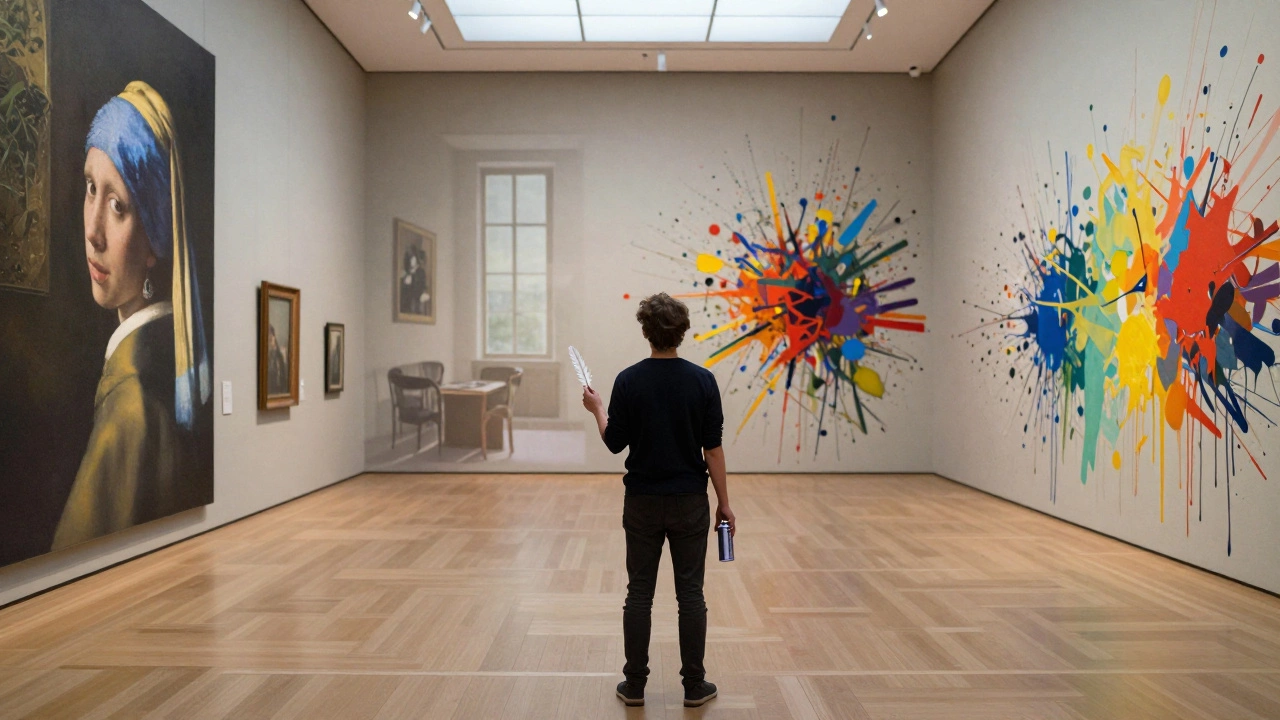
Modern art didn’t kill traditional art. It expanded what art could be. Today, you’ll find galleries showing both side by side. A 17th-century portrait hangs next to a 1960s abstract expressionist piece. They don’t compete-they dialogue.
Modern art didn’t erase the past. It forced us to ask: What is art for? And who gets to decide?
If you’ve ever stood in front of a blank canvas and wondered, "Is this really art?"-you’re not alone. That question is the heartbeat of modern art. And it’s why we still care.
Is modern art just random splatters with no skill?
No. While some modern art looks simple, it often requires deep thought, timing, and intention. Jackson Pollock’s drip paintings, for example, involved precise control of paint viscosity, body movement, and rhythm. The "randomness" was carefully engineered. Skill in modern art isn’t about drawing a perfect hand-it’s about making a powerful idea visible.
Can traditional and modern art be combined today?
Absolutely. Many contemporary artists blend techniques. An artist might paint a hyper-realistic face using Renaissance methods, then overlay it with abstract digital textures. Or sculpt a classical bust from bronze, then place it in a neon-lit installation. Modern tools and ideas don’t erase tradition-they give artists more ways to speak.
Why did modern art start in the 19th century?
Three big changes triggered it: photography made realistic painting less necessary, industrialization changed how people lived, and new philosophies (like Darwin’s evolution or Freud’s unconscious mind) challenged old beliefs. Artists felt they couldn’t paint the world the old way anymore. They needed new languages to express a new reality.
Is contemporary art the same as modern art?
No. Modern art refers to work from roughly 1860 to 1970. Contemporary art is what’s being made today-after 1970. Modern art broke the rules. Contemporary art asks: "What rules are left to break?" It’s more global, digital, and politically engaged. Think Banksy or Yayoi Kusama-artists who respond to today’s world, not just the past.
Do museums value modern art more than traditional art?
Not necessarily. Major museums like the Louvre or the Met hold both in high regard. But modern art often sells for more at auction because it’s rarer and more culturally symbolic. A Picasso can fetch $100 million, but a Rembrandt might be priceless because it’s irreplaceable. Value isn’t about which is better-it’s about context, history, and demand.