Sculpture Technique Explorer
Select your goal or the feeling you want to achieve to discover the ideal sculptural approach:
Reveal a Form
I want to start with a solid block and remove material to find the hidden shape inside.
Build from Scratch
I want to start with nothing and add material layer by layer to grow my piece.
Duplicate & Preserve
I want to create a mold and produce a durable, permanent version of my work.
Combine Objects
I want to use found materials and everyday objects to create a new meaning.
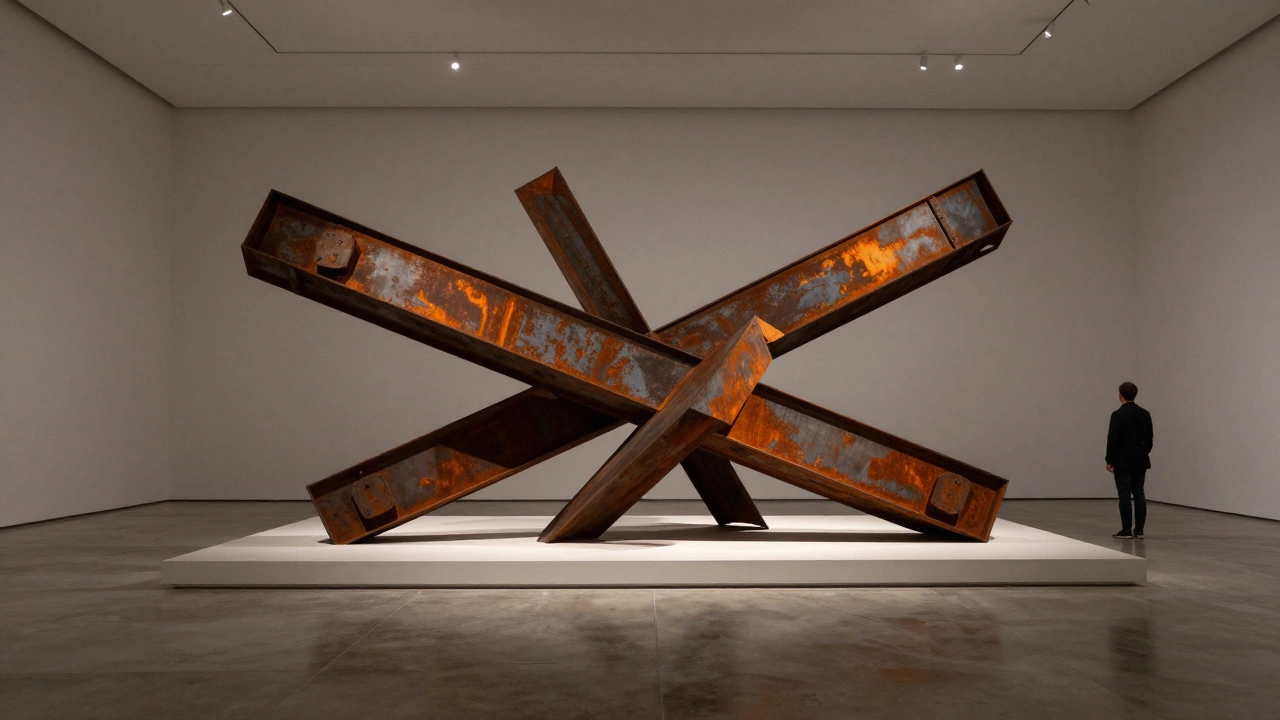
Imagine walking into a room and seeing a massive, jagged piece of rusted steel that looks like it belongs in a scrapyard, yet it's perched on a pedestal in a million-dollar gallery. You might find yourself asking, "Is this actually art, or just a weird pile of metal?" This question gets to the heart of a common curiosity: do sculptures actually count as artwork? The short answer is a resounding yes, but the way we define that "yes" has shifted wildly over the last few thousand years.
Quick Takeaways on Sculpture as Art
- Sculpture is one of the oldest forms of human expression, predating written history.
- It is defined by its three-dimensional nature, occupying actual physical space.
- Modern art has expanded the definition to include "found objects" and digital 3D prints.
- The value lies in the intersection of material, form, and the viewer's perspective.
The DNA of Three-Dimensional Art
To understand why sculpture is art, we first have to define what we're talking about. In the world of sculpture art is the branch of the visual arts that operates in three dimensions. Unlike a painting, which tricks your eye into seeing depth on a flat surface, a sculpture actually has depth. You can walk around it, touch it (though museums usually forbid that), and see how light hits it from different angles.
Think about the difference between a photo of a mountain and an actual mountain. One is a representation; the other is a physical presence. Sculpture bridges that gap. Whether it's a tiny ivory carving from the Middle Ages or a massive concrete installation in a city square, it changes the environment around it. It doesn't just sit on a wall; it claims a piece of the room.
The Evolution of Materials: From Stone to Plastic
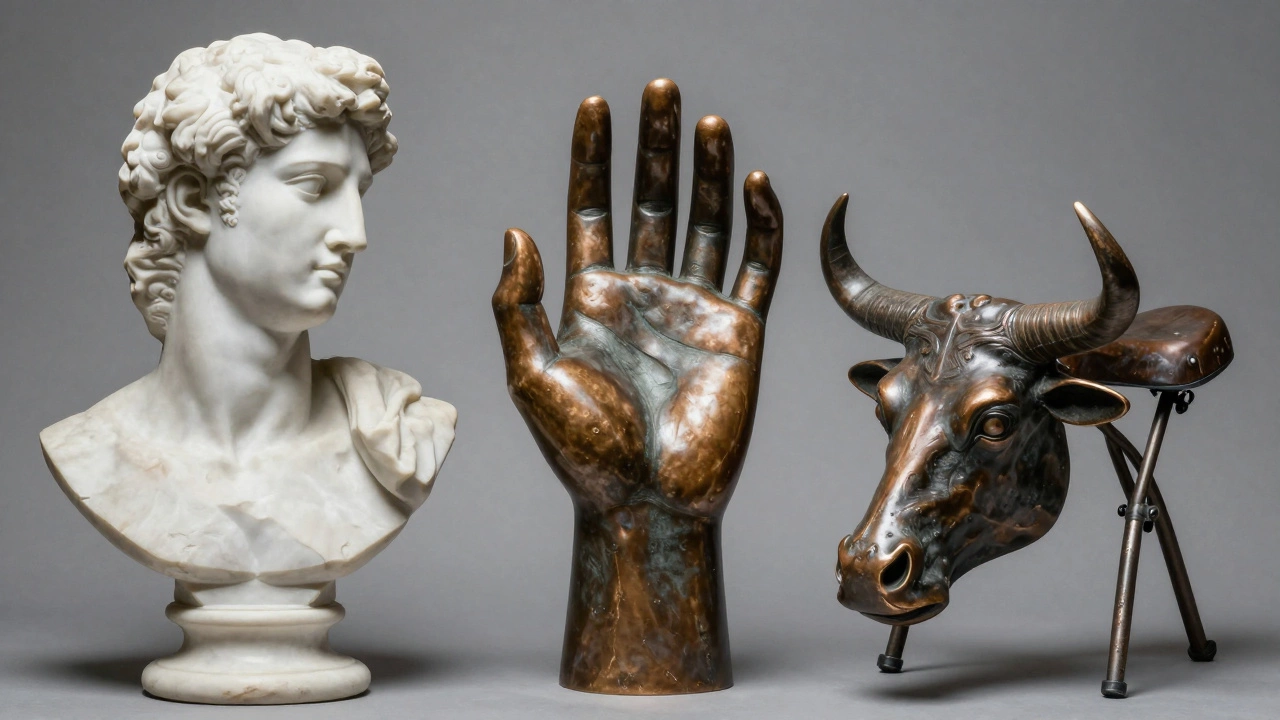
For a long time, people thought "real" sculpture had to be carved from Marble or cast in Bronze. If it wasn't a Greek god in white stone or a royal bust in metal, it wasn't considered "fine art." But as our understanding of creativity grew, so did our toolkit.
In the early 20th century, artists started experimenting. They realized that the artistic expression wasn't just in the skill of carving, but in the choice of material. This led to the rise of "assemblage," where artists combined random bits of wood, cloth, and metal. If you look at the works of Pablo Picasso, he often used found objects-like a bicycle seat and handlebars-to create a bull's head. This proved that the "artwork" isn't the material itself, but the idea behind how those materials are arranged.
| Technique | Common Materials | Key Characteristic | Example Context |
|---|---|---|---|
| Subtractive | Stone, Wood, Ivory | Removing material to find the form | Michelangelo's David |
| Additive | Clay, Wax, Plaster | Building up material layer by layer | Pottery and Maquettes |
| Casting | Bronze, Resin, Concrete | Pouring liquid into a mold | Public monuments |
| Assemblage | Found objects, Scrap metal | Joining disparate parts together | Modernist installations |
Is Every 3D Object a Sculpture?
This is where things get tricky. If you go to an IKEA store and buy a chair, is that a sculpture? Technically, it's three-dimensional. However, there's a big difference between industrial design and fine art. Industrial design focuses on utility-the chair is meant to be sat on. Sculpture focuses on meaning, emotion, or aesthetic exploration.
However, the line is thinner than you might think. Consider the Readymades introduced by Marcel Duchamp. He took a standard porcelain urinal, signed it "R. Mutt," and called it *Fountain*. By placing a mass-produced object in a gallery and calling it art, he argued that the act of choosing the object and giving it a new context is the actual creative act. This flipped the world of art on its head and cemented the idea that any 3D object can be artwork if the intent is there.
The Role of Space and the Viewer
One thing that makes sculpture unique is the relationship it has with the viewer. When you look at a painting, you are a spectator. When you encounter a sculpture, you are a participant. You have to move your body to see the whole piece. This is called "phenomenology"-the study of conscious experience.
Imagine a giant steel loop by Richard Serra. As you walk through the curve of the steel, the walls feel like they are leaning in on you, and the sound of your footsteps changes. The art isn't just the steel; it's the feeling of being inside that space. This turns the environment itself into part of the artwork. It's no longer just about "looking" at something; it's about experiencing it with your entire body.
Modern Frontiers: Digital and Kinetic Sculpture
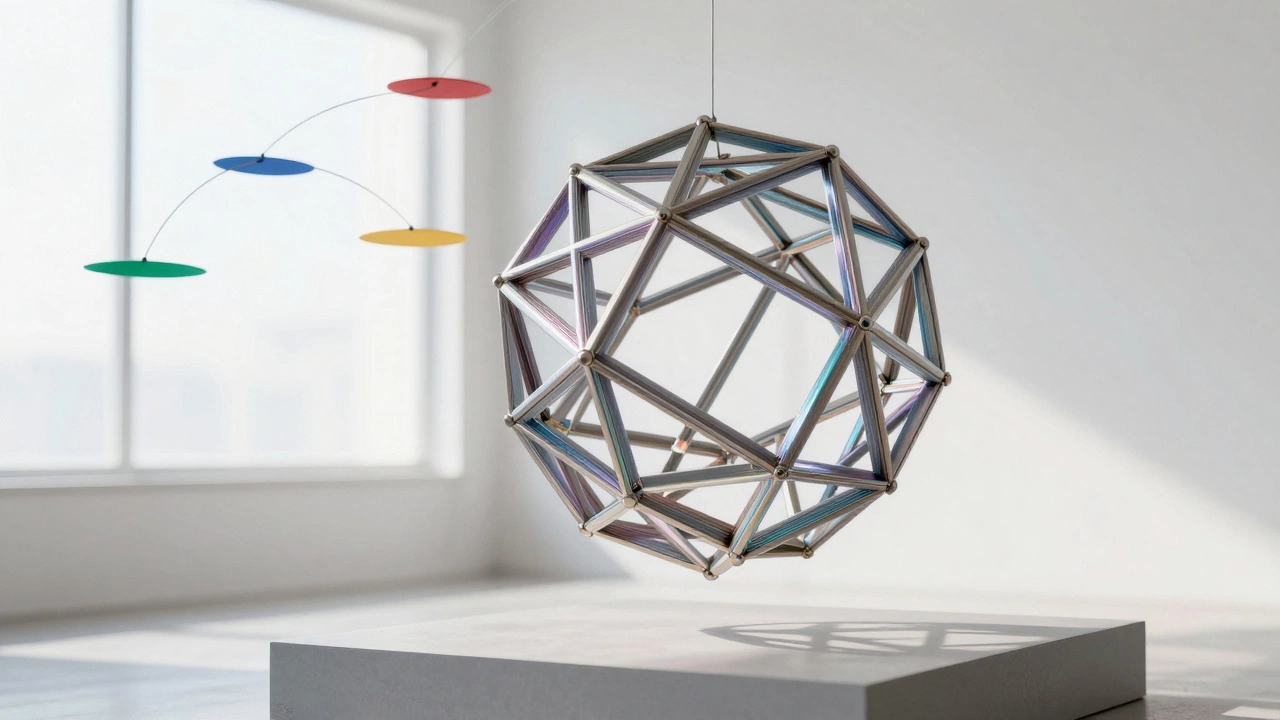
We've moved far beyond chisels and hammers. Today, we have 3D Printing, which allows artists to create geometries that would be physically impossible to carve by hand. An artist can design a complex, interlocking lattice in a software program and then "print" it in resin or titanium. Does this count as sculpture? Absolutely. The tool has changed, but the goal-creating a physical form in space-remains the same.
Then there's kinetic sculpture. These are artworks that move. Think of the mobiles created by Alexander Calder, which drift slowly in the breeze. Here, time and gravity become the "materials." The sculpture isn't a static object; it's a performance. The movement adds a layer of unpredictability, making the artwork feel alive.
Why Sculpture Matters in the Big Picture
If we only had 2D art, our visual world would be incredibly flat. Sculpture provides a physical anchor for human history. When we look at the Terracotta Army in China, we aren't just seeing figures; we are seeing the scale, the ambition, and the social structure of an ancient empire. The sheer mass of the work communicates power in a way a painting never could.
In our modern, screen-dominated lives, physical sculpture is more important than ever. There is something deeply satisfying about seeing an object that exists in the same physical reality as we do. It reminds us of the tactile world-the roughness of stone, the coldness of steel, the softness of wax. It forces us to slow down and move through a space, rather than just scrolling through a feed.
Does a 3D digital model count as a sculpture?
Yes, in the context of digital art, 3D modeling is often referred to as "digital sculpting." While it doesn't have physical mass until it's printed, it follows the same principles of form, volume, and spatial relationship as traditional sculpture.
Is architecture considered a form of sculpture?
There is a huge overlap. While architecture is primarily about utility and shelter, many architects (like Frank Gehry or Zaha Hadid) design buildings that function as massive sculptures. When a building's form is driven more by aesthetic expression than by function, it's often called "sculptural architecture."
What makes something a "fine art" sculpture versus a craft?
The distinction is often based on intent. "Craft" usually refers to objects made for a functional purpose (like a ceramic bowl). "Fine art" sculpture is generally created to convey an idea, evoke an emotion, or explore a concept, where the primary value is aesthetic or intellectual rather than practical.
Can sculpture be temporary?
Definitely. This is often called "ephemeral art." Some artists create sculptures out of ice, sand, or even food. The fact that the work disappears is often a core part of the artwork's meaning, commenting on the nature of time and decay.
Why are sculptures often placed in public parks?
Public sculpture serves several purposes: it beautifies urban spaces, commemorates historical events, and makes art accessible to people who might not visit a museum. Because they are durable, materials like bronze and granite are perfect for enduring the elements while speaking to the community.
Next Steps for Art Lovers
If you're curious about exploring this further, start by visiting a local gallery and paying attention to how your body reacts to different pieces. Try walking around a sculpture and noticing how the shape changes from every angle. If you're feeling adventurous, try a simple additive project at home-grab some air-dry clay and focus on creating a form that feels "balanced" rather than one that looks like a specific object. Once you start thinking in 3D, you'll realize that the world is full of sculptures; you just have to look at it from a different perspective.