Nov 11, 2025
Spotify vs Apple Music: Which Streaming Service Actually Wins in 2025?
When you paint scenery, a visual representation of natural or outdoor environments, often including land, water, sky, and vegetation. Also known as landscape painting, it’s not just about copying what you see—it’s about arranging light, space, and color to make the viewer feel like they’re standing there. Many beginners think scenery painting means slapping on green for grass and blue for sky, but the real magic happens in how you build depth. You don’t just paint a picture—you build a world.
Every great landscape relies on three layers: foreground, the part of the scene closest to the viewer, often filled with detail like rocks, grass, or paths, middle ground, where the main subject usually lives—hills, trees, or buildings that anchor the composition, and background, the farthest layer, softened with lighter colors and less detail to suggest distance. These layers work together like stages in a play. If the foreground is too busy, it steals attention. If the background is too sharp, the scene feels flat. The trick? Let each layer breathe. Use cooler, lighter tones in the back. Push warmer, richer colors forward. That’s how you create space without a ruler.
Light is your silent partner. It doesn’t just shine—it shapes. Notice how the sun hits a hillside in Pembrokeshire at sunset: the warm side glows, the shadow side turns cool and deep. That contrast is what makes a painting feel real, not like a postcard. You don’t need fancy brushes or expensive paints. A good brushstroke, a smart mix of colors, and knowing where to leave space are what matter most. Artists here don’t paint every leaf—they paint the feeling of wind through them.
Some people think you need to travel to mountains or oceans to paint great scenery. You don’t. A quiet lane, a field behind your house, even a puddle reflecting clouds—those are your subjects. The best landscapes come from paying attention, not from perfect conditions. That’s why you’ll find artists in Pembrokeshire painting rain-slicked cliffs, mist over estuaries, and sheep grazing in fields under gray skies. They’re not waiting for perfect weather. They’re painting what’s real.
What follows is a collection of guides that cut through the noise. You’ll find exactly how to use the rule of thirds in a landscape, how to pick colors that don’t turn muddy, and why adding a single figure can change everything. Whether you’re using oil, watercolor, or digital tools, the principles stay the same. No fluff. No theory without practice. Just what works when you’re standing there with a brush in hand, trying to make the world on paper feel like the one outside your window.
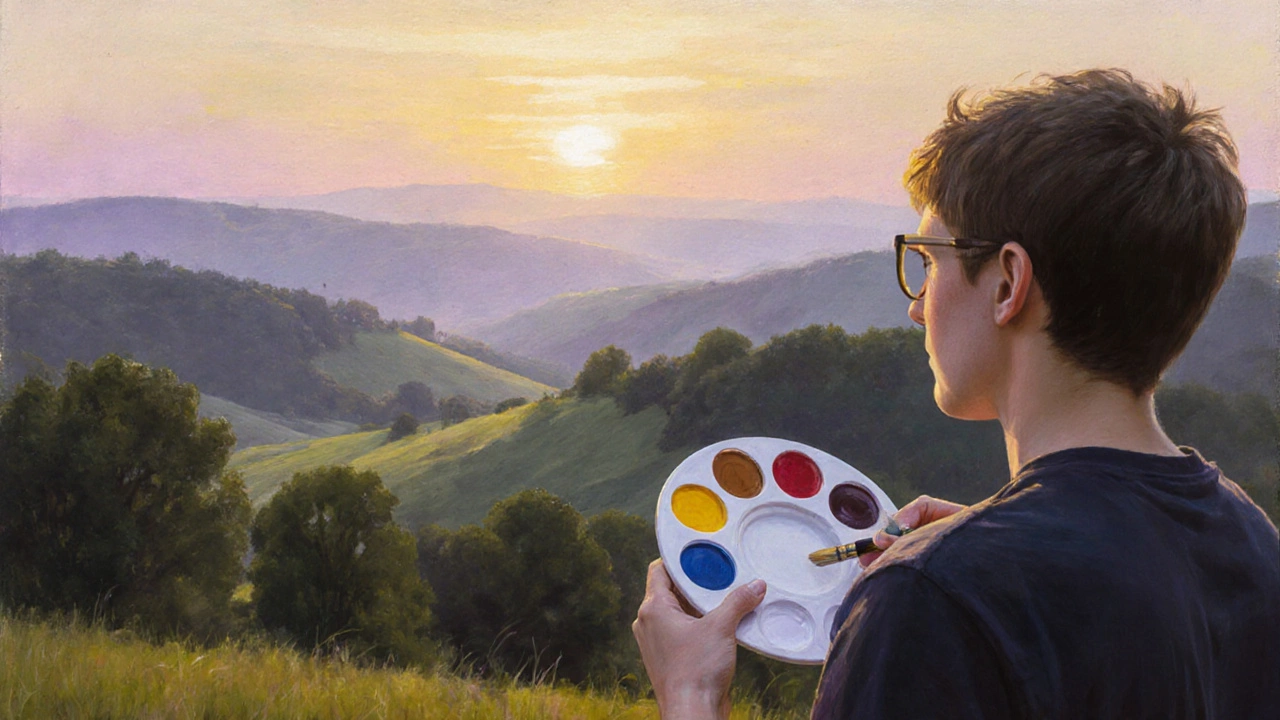
Learn how to paint realistic landscapes by focusing on light, value, and atmospheric perspective instead of details. Step-by-step techniques for beginners using oil or acrylics.