Watercolor Paper Soaking Calculator
Is Soaking Needed?
Select paper weight and techniques to see if soaking is recommended
Ever stretched your watercolor paper only to have it buckle like a crumpled napkin halfway through your painting? Or watched your washes bleed uncontrollably because the paper couldn’t hold the water? You’re not alone. The question of whether to soak watercolor paper before painting comes up in nearly every beginner’s forum-and even seasoned artists disagree. Some swear by it. Others say it’s a waste of time. So what’s the truth?
What soaking watercolor paper actually does
Soaking watercolor paper means fully submerging it in water for 5 to 15 minutes before stretching or taping it down. The goal isn’t to make the paper wetter-it’s to let the fibers expand evenly. Watercolor paper is made from cotton or cotton-and-cellulose fibers, and these fibers swell when they absorb water. If they swell unevenly during painting, the paper warps. That’s when you get ridges, bubbles, and uneven paint application.
Soaking ensures every fiber expands at the same rate. When you tape the soaked paper to a board and let it dry flat, it dries taut like a drumhead. That’s the secret: it’s not about wetting the surface for better paint flow-it’s about preventing distortion before you even pick up a brush.
When soaking makes a difference
Not all watercolor papers need soaking. It’s only necessary for papers under 300 gsm (grams per square meter). Papers at 300 gsm and above are thick enough to handle multiple washes without buckling-especially if you’re using a light touch.
But if you’re working with 140 gsm paper-the most common weight for beginners-and you plan to use heavy washes, wet-on-wet techniques, or large areas of color, skipping the soak is asking for trouble. I’ve seen students paint a sky over a 140 gsm sheet, only to have the paper lift off the board like a sail in the wind. No amount of masking tape fixes that.
Soaking also helps with control. When the paper is evenly saturated and then taped down to dry, it holds pigment better. Washes spread smoothly instead of pooling. Edges stay crisp because the paper doesn’t shift as it dries. It’s not magic-it’s physics.
How to soak watercolor paper the right way
There’s a right way and a wrong way to soak paper. Here’s the simple, foolproof method:
- Fill a clean tub, sink, or tray with lukewarm water-no soap, no additives.
- Place your sheet of paper flat on the water. Don’t push it down or fold it. Let it float.
- Wait 5 minutes for 140 gsm paper. For 200 gsm, go 8 to 10 minutes. For 300 gsm, you don’t need to soak at all.
- Carefully lift the paper by two corners. Let excess water drip off for 30 seconds.
- Place it on a flat, absorbent surface-a clean towel or foam board-and gently blot the surface with another towel. Don’t rub.
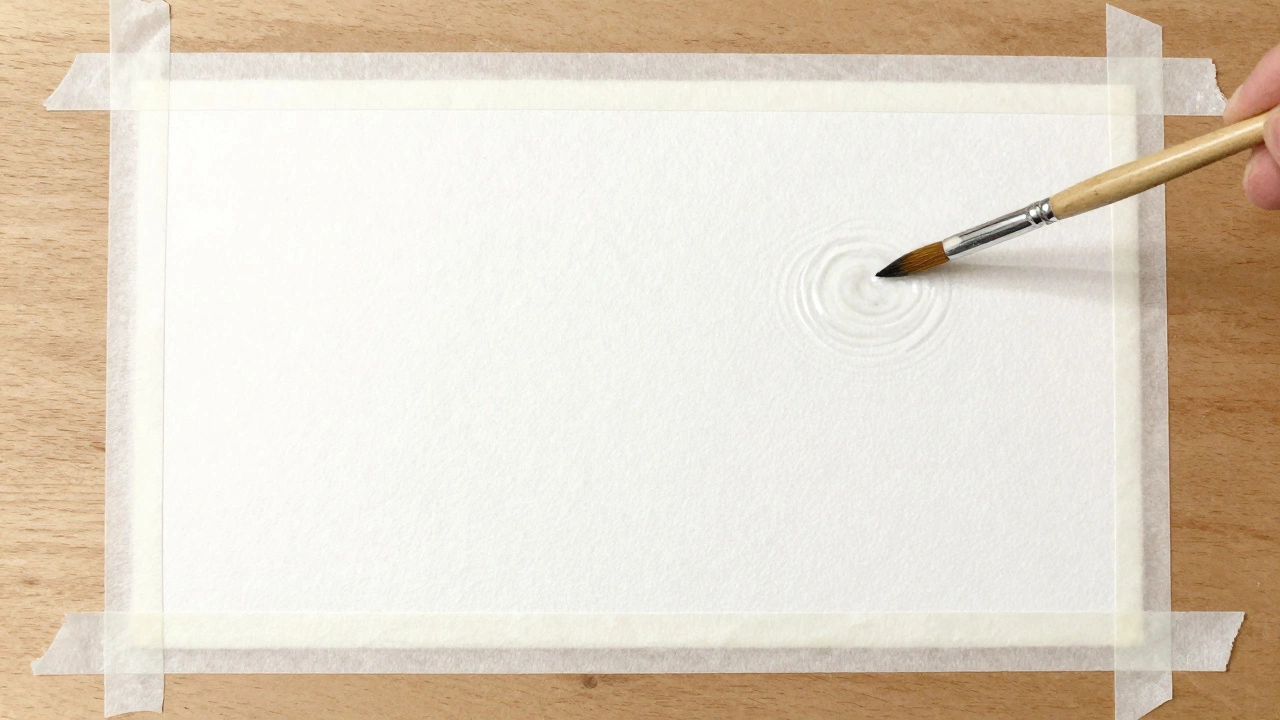
- Immediately tape all four edges down with artist’s tape (not masking tape) onto a rigid board. Let it dry completely before painting.
Don’t skip the blotting step. Too much water left on the surface will cause the tape to peel. And never use hot water. It can damage the sizing-the coating that controls how water and pigment behave on the paper.
What about just wetting the paper instead of soaking?
Some artists skip soaking and just spray or sponge water onto the surface. That’s fine for quick sketches or small areas, but it’s not the same. Spraying creates uneven moisture. You might get a damp patch where you want it, but the corners stay dry. That leads to warping.
Soaking ensures full saturation from edge to edge. It’s the only method that gives you consistent, predictable results-especially if you’re working on larger pieces or doing multiple layers.
When you shouldn’t soak
Soaking isn’t always the answer. Avoid it if:
- You’re using paper that’s 300 gsm or heavier-most brands like Arches, Saunders Waterford, or Fabriano Artistico are designed to handle washes without stretching.
- You’re doing dry-brush techniques, fine details, or ink line work. Wet paper makes control harder.
- You’re in a hurry. Soaking and drying can take 2 to 4 hours. If you’re painting on the go, use a heavier paper instead.
- You’re using cold press paper with a very rough texture. Soaking can soften the texture too much, making it harder to preserve brushstroke definition.
There’s also the issue of sizing. Papers with less sizing (like some student-grade brands) can become too soft after soaking and tear easily. If your paper feels mushy after soaking, switch to a higher-quality brand.
Alternatives to soaking
If soaking feels too fussy, here are two reliable alternatives:
1. Use 300 gsm paper - It’s thicker, more stable, and doesn’t need stretching. Brands like Arches 300 gsm cold press are widely available and handle multiple washes without warping. It’s a bit pricier, but you save time and frustration.
2. Tape directly to a board without soaking - If you’re using 140 gsm paper and you’re careful with water, you can tape it down dry and paint slowly. Use less water in your brush. Let each layer dry fully before adding the next. This works for smaller paintings or controlled washes-but don’t try it with a big sky or a flooded landscape.
There’s no single right way. But if you want consistent, professional results-especially on 140 gsm paper-soaking is the most reliable method.
What happens if you skip soaking?
You might get lucky. Some artists paint beautiful work on unsized, unstretched paper. But more often, you’ll run into problems:
- Paper curls up at the edges during painting.
- Washes pool unevenly because the surface isn’t flat.
- Paint lifts off in patches when you re-wet areas.
- After drying, your painting looks wrinkled and amateurish.
These aren’t style choices-they’re mistakes caused by uncontrolled expansion. Once your paper warps, there’s no fixing it. You can’t iron it. You can’t flatten it with books. The damage is permanent.
Final tip: Test your paper
Not all papers behave the same. Even within the same weight, different brands have different sizing and fiber blends. Try this quick test: Cut a 2-inch square from your paper. Soak it for 5 minutes, then tape it down and let it dry. If it curls or wrinkles, your paper needs soaking. If it stays flat, you’re good to go.
Do this once with your favorite brand. You’ll know for sure whether soaking is worth your time.
Bottom line
Soaking watercolor paper isn’t optional if you’re using 140 gsm paper and want to avoid buckling. It’s a simple, low-cost step that gives you control, predictability, and professional results. Skip it on heavier papers. Use it on lighter ones. And never assume your paper will behave the same way as someone else’s.
Watercolor is all about managing water. Soaking your paper isn’t about making it wetter-it’s about making it stable. And stability is what turns a messy wash into a smooth, controlled painting.