Sculpture Identity Profiler
Answer these questions honestly to see where your creative drive lies.
Take the Quiz
Select your answers above to discover whether your approach aligns more with the Fine Art tradition or the Artisan Craft tradition.
Walk into a high-end gallery in Vancouver, New York, or London, and you’ll see a bronze figure commanding a $50,000 price tag. Walk into a local hardware store or a traditional workshop, and you might see someone chipping away at stone for a garden ornament priced at $200. Both are sculptures. Both require immense skill. Yet society treats them differently. One is "art," elevated by theory and ego. The other is "craft," valued for utility and technique. So, is a sculptor an artist or an artisan? The short answer is that they are often both, but the distinction matters because it dictates how we value labor, creativity, and the object itself.
The Historical Divide: Guilds vs. Academies
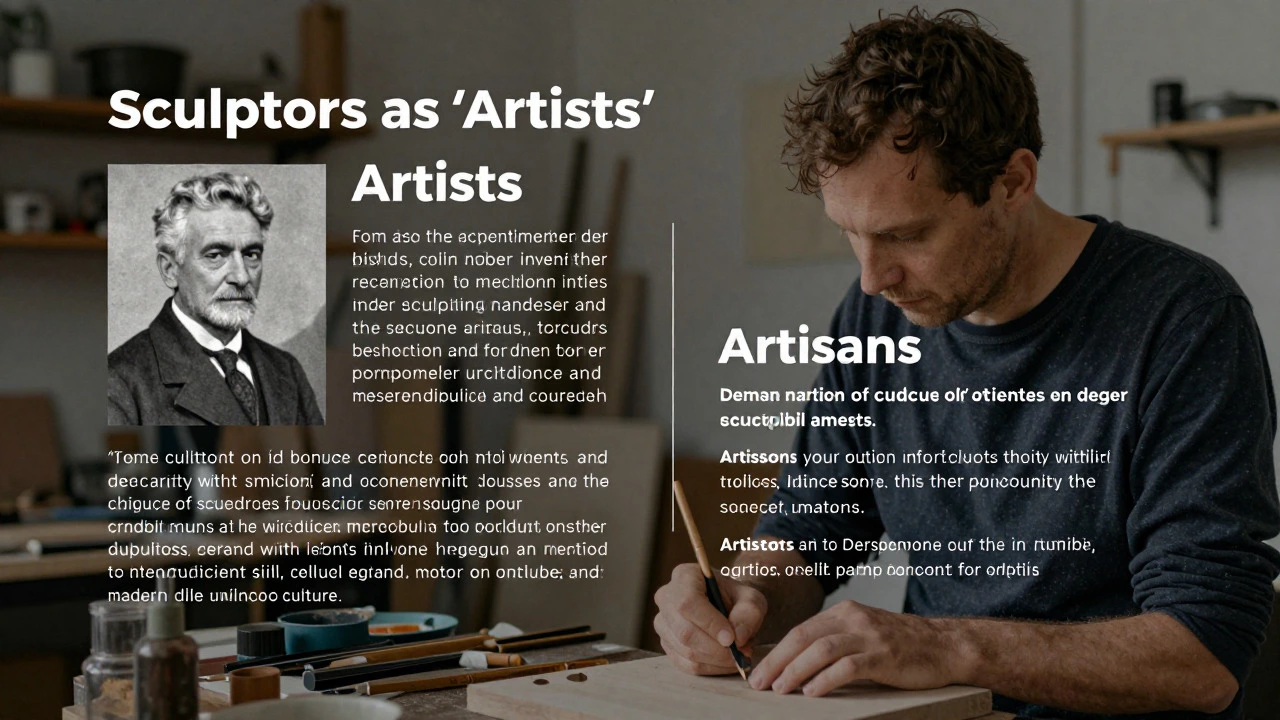
To understand why this question even exists, we have to look back at where these labels came from. For centuries, the line between artisan a skilled worker who practices a trade, often involving manual dexterity and precision and artist a creator of works valued primarily for their aesthetic or intellectual qualities was drawn by social class, not talent. In medieval Europe, artisans belonged to guilds. They were craftsmen-masons, carpenters, metalworkers-who produced functional objects or religious icons for patrons. Their work was collaborative, standardized, and rooted in tradition.
Fast forward to the Renaissance, and things shifted. Figures like Michelangelo began to be celebrated not just as skilled workers, but as divine geniuses. The concept of the "fine arts" emerged, separating painting, sculpture, and architecture from the "mechanical arts" (crafts). This created a hierarchy. If your sculpture served a practical purpose-a fountain, a tombstone, a decorative vase-it was craft. If it expressed personal vision, emotion, or philosophical ideas, it was fine art. This historical baggage still influences how we view sculptors today.
Defining the Roles: Intent vs. Execution
So, how do we tell them apart now? It usually comes down to intent. An artisan focuses on mastery of material and function. A master woodcarver creating intricate furniture legs isn’t trying to make a statement about the human condition; they are demonstrating excellence in joinery and design within a functional context. The value lies in the execution, the durability, and the beauty of the form serving its purpose.
An artist an individual whose primary goal is to express ideas, emotions, or concepts through creative work, on the other hand, prioritizes expression. When Rodin sculpted *The Thinker*, he wasn’t making a chair or a door handle. He was exploring contemplation, anguish, and the human form. The technical skill is there, but it serves the idea. If the idea is weak, the piece fails as art, regardless of how perfectly the marble is polished.
However, this binary is increasingly outdated. Many contemporary sculptors blur the lines intentionally. They use industrial materials, collaborate with engineers, and create works that are both visually stunning and structurally sound public installations. Are they artists or artisans? They are hybrid practitioners who refuse to choose.
| Feature | Artist (Fine Art) | Artisan (Craft) |
|---|---|---|
| Primary Goal | Expression, concept, emotional impact | Function, utility, technical mastery |
| Value Driver | Originality, reputation, rarity | Quality of materials, durability, craftsmanship |
| Training Focus | Critical theory, conceptual development, studio practice | Technical skills, material properties, tool safety |
| Output | Unique pieces, limited editions | Functional objects, reproducible designs |
| Market Context | Galleries, museums, auctions | Retail, commissions, custom orders |
The Material Reality: Skill Is Non-Negotiable
Let’s get one thing straight: being called an "artist" doesn’t mean you can skip the hard work. In fact, many people mistakenly believe that fine art sculpture is less technically demanding than craft. This is false. Carving granite requires the same physical strength and understanding of fracture planes whether you’re making a abstract monolith or a detailed statue of a saint. Casting bronze involves toxic fumes, precise temperature control, and complex mold-making processes that demand years of apprenticeship.
The difference isn’t the difficulty of the task; it’s the freedom to fail. An artisan working on a commissioned table leg cannot afford to ruin the expensive hardwood. The margin for error is slim. An artist in a studio might smash a clay model ten times before finding the right gesture. The artistic process embraces destruction and iteration as part of discovery. The artisanal process emphasizes efficiency and consistency.
This brings us to the concept of materiality the quality of being composed of matter; in art, how the physical substance contributes to the meaning. In craft, materiality is often about showcasing the natural beauty of the wood, stone, or metal. In fine art, materiality can be subverted. An artist might use rusted steel to evoke decay, or plastic to comment on consumerism. The material becomes a metaphor, not just a medium.
Why the Distinction Matters Today
In the modern economy, the label you carry affects your livelihood. Galleries represent "artists." Etsy shops and local markets sell "artisan" goods. Museums collect "art." Homeowners buy "decor." These categories dictate pricing, insurance, and critical attention.
If you identify as an artisan, you are expected to deliver consistent quality and meet client specifications. Your success depends on reliability and technical perfection. If you identify as an artist, you are expected to innovate and challenge norms. Your success depends on building a narrative and cultivating a following that believes in your vision.
But here’s the trap: many sculptors feel pressured to abandon the "artisan" label to gain prestige, while others cling to it to avoid the instability of the fine art market. This creates a false dichotomy. Consider James Turrell, who uses light and space to create immersive environments. His work requires engineering precision akin to high-level craftsmanship, yet it is universally regarded as high art. Or consider a master luthier who builds violins. Their work is functional, but the level of acoustic refinement and aesthetic detail elevates it to an art form.
Bridging the Gap: The Rise of Maker Culture
We are currently living in a renaissance of making. The digital fabrication revolution, with tools like 3D printers and CNC routers, has democratized access to production. Suddenly, anyone can produce complex forms. This has blurred the lines further. A designer using a 3D printer to create a unique lampshade is operating in the space between artist and artisan. They are designing (creative) and manufacturing (technical).
This shift encourages us to stop asking "which one are you?" and start asking "what are you trying to achieve?" If your goal is to solve a problem or create a beautiful object for daily use, lean into the artisan identity. If your goal is to provoke thought, explore identity, or critique society, lean into the artist identity. Most importantly, respect the skill required for both. Dismissing craft as "less than" art ignores the thousands of hours of practice behind every clean cut and smooth finish. Conversely, dismissing art as "pretentious" ignores the intellectual rigor and emotional vulnerability required to create meaningful work.
Finding Your Path
For those starting out in sculpture, don’t let the label paralyze you. Start with the material. Learn how clay behaves, how wood grain moves, how metal flows. Technical proficiency is the foundation of both art and craft. Without it, your ideas will remain trapped in your head. With it, you have the vocabulary to speak.
Once you have the skills, ask yourself what you want to say. Do you want to create objects that enhance everyday life? Then study ergonomics, durability, and design principles. Do you want to create experiences that challenge viewers? Then study art history, philosophy, and contemporary theory. You can do both. Many of the most respected figures in the field move fluidly between these modes. They accept commissions for public monuments (artisanal scale, artistic vision) while also producing small-scale experimental pieces for galleries (pure art).
Ultimately, sculpture is a dialogue between the maker and the material. Whether you call yourself an artist or an artisan, you are participating in a tradition that spans millennia. The chisel, the welder, the 3D printer-they are all tools. The difference lies in the intention behind the hand that holds them.
Is pottery considered art or craft?
Pottery sits squarely in the middle. Functional ceramics like mugs and bowls are traditionally viewed as craft due to their utility. However, when potters create non-functional vessels or use clay to explore conceptual themes, their work is exhibited in galleries as fine art. The distinction depends on whether the piece is meant to be used or contemplated.
Do artists need to know how to make their own sculptures?
Not necessarily. Many contemporary artists act as directors, conceiving the idea and collaborating with fabricators, engineers, or foundries to execute the work. This is similar to how architects design buildings but don’t lay the bricks. However, having hands-on experience helps artists communicate effectively with technicians and understand the limitations of materials.
Which pays better: being an artist or an artisan?
It varies wildly. Successful artisans with established brands can earn stable, high incomes selling functional goods online or through retail partnerships. Fine artists face more income volatility; a few may earn millions, while many struggle financially. Generally, artisanal work offers more predictable revenue streams, while fine art offers higher potential ceilings but greater risk.
Can something be both art and craft?
Absolutely. Many objects possess both aesthetic depth and functional utility. A beautifully carved wooden spoon, for example, serves a purpose but also delights the eye and reflects the maker’s style. The term "design" often bridges this gap, acknowledging both form and function without forcing a rigid classification.
How do museums decide what to collect?
Museums typically focus on fine art, prioritizing historical significance, innovation, and cultural impact. However, some institutions, like the Victoria and Albert Museum in London, specialize in decorative arts and design, collecting high-quality crafts. The decision depends on the museum’s mission and whether the object contributes to a broader narrative about culture and creativity.