Fibonacci Canvas Composition Planner
Enter your canvas dimensions to calculate the optimal focal points using the Golden Ratio (Phi ≈ 1.618). This tool helps you place elements according to classical aesthetic principles.
Composition Calculations
- Primary Vertical Division: -- inches from left edge.
- Primary Horizontal Division: -- inches from top edge.
- Focal Point Coordinates: --
Note: The Golden Ratio is approximately 1.618. For a landscape canvas, divide the longer side by this number to find the primary division line. Place your main subject near the intersection of these lines or along the golden spiral curve for natural visual flow.
You’ve probably heard the term thrown around in art classes or read about it in design blogs. The Fibonacci sequence is a mathematical pattern that appears everywhere in nature, from pinecones to galaxies. But what does a string of numbers have to do with making your next oil painting look balanced and beautiful? It’s not just abstract theory. It’s a practical tool for composition.
Here’s the thing: most artists don’t think in equations when they’re mixing pigments on their palette. We think in shapes, colors, and feelings. Yet, our eyes are wired to find certain arrangements pleasing. That’s where the Fibonacci sequence steps in. It helps you place elements in your artwork so they feel naturally right, without looking forced or rigid.
| Concept | Mathematical Definition | Artistic Application |
|---|---|---|
| Fibonacci Sequence | A series where each number is the sum of the two preceding ones (0, 1, 1, 2, 3, 5, 8...) | Used to determine proportional spacing and element sizing. |
| Golden Ratio | The limit of the ratio between consecutive Fibonacci numbers (approx. 1.618) | Guides the placement of focal points for maximum visual appeal. |
| Golden Spiral | A logarithmic spiral whose growth factor is the Golden Ratio | Creates dynamic movement and leads the viewer’s eye through the canvas. |
Why Numbers Matter in Your Studio
Let’s cut through the confusion. The Fibonacci sequence starts with 0 and 1. Each subsequent number is the sum of the previous two. So, you get 0, 1, 1, 2, 3, 5, 8, 13, 21, and so on. As these numbers get larger, the ratio between one number and the one before it gets closer and closer to 1.618. This specific ratio is known as the Golden Ratio, often represented by the Greek letter Phi (Phi). It is considered the basis for aesthetic perfection in classical art and architecture.
Why should an oil painter care? Because symmetry isn’t always interesting. Perfect symmetry can feel static, like a mirror image. The Golden Ratio offers something different: asymmetrical balance. It creates tension and release, guiding the eye naturally across the canvas. When you use this ratio, your composition feels organic, much like the branches of a tree or the curve of a wave.
Think about Leonardo da Vinci. His famous work, The Vitruvian Man, wasn’t just about anatomy; it was about proportion. While some claims about his strict adherence to the Golden Ratio are debated, the principle influenced centuries of Renaissance art. You don’t need to be a mathematician to benefit from this legacy. You just need to understand how to divide your space.
Translating Math into Brushstrokes
How do you actually use this while painting? You don’t pull out a calculator every time you pick up a brush. Instead, you use visual guides. The most common application is the Rule of Thirds, which is a simplified version of the Golden Ratio grid. Imagine dividing your canvas into nine equal parts using two horizontal and two vertical lines. The intersections of these lines are power points. Placing your main subject near one of these intersections usually creates a more engaging image than placing it dead center.
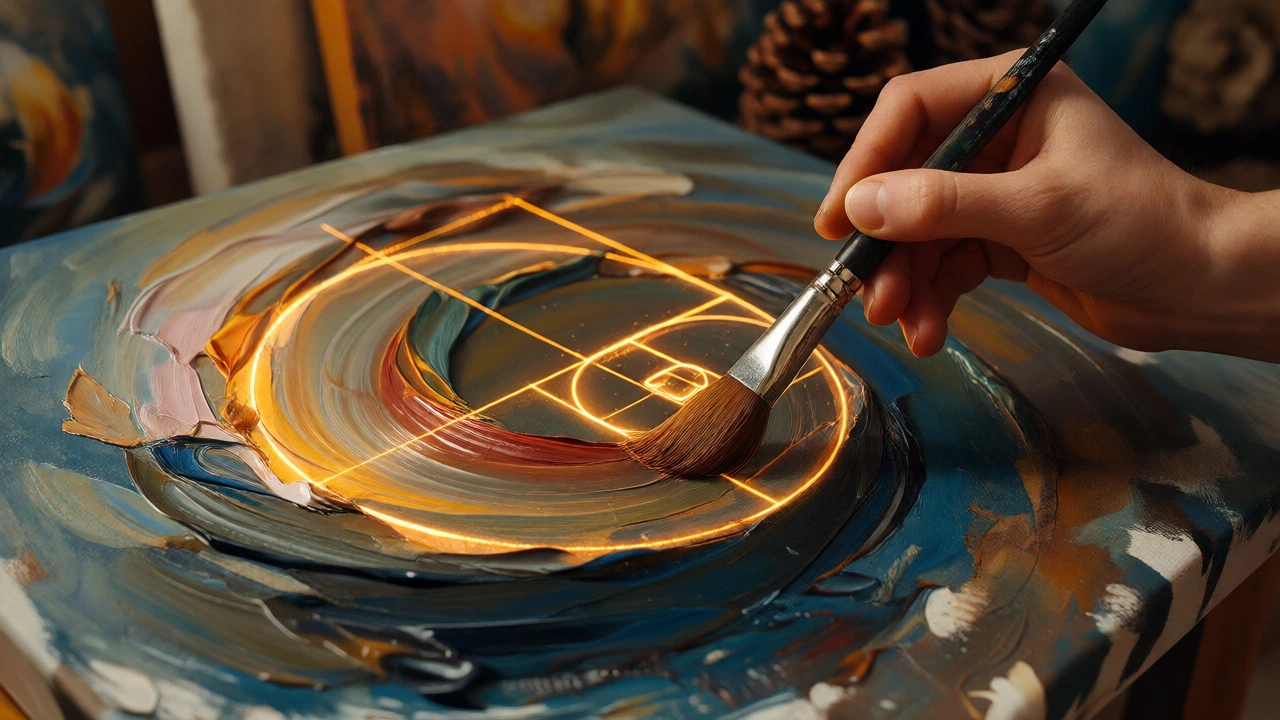
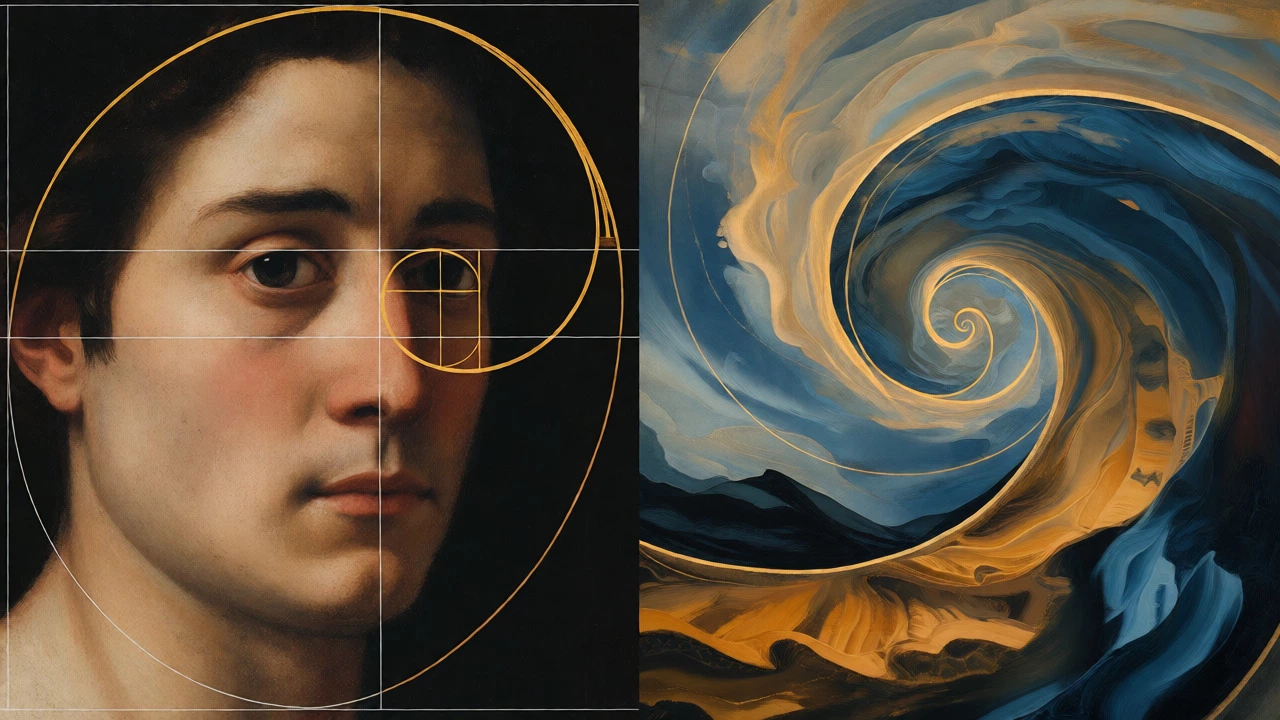
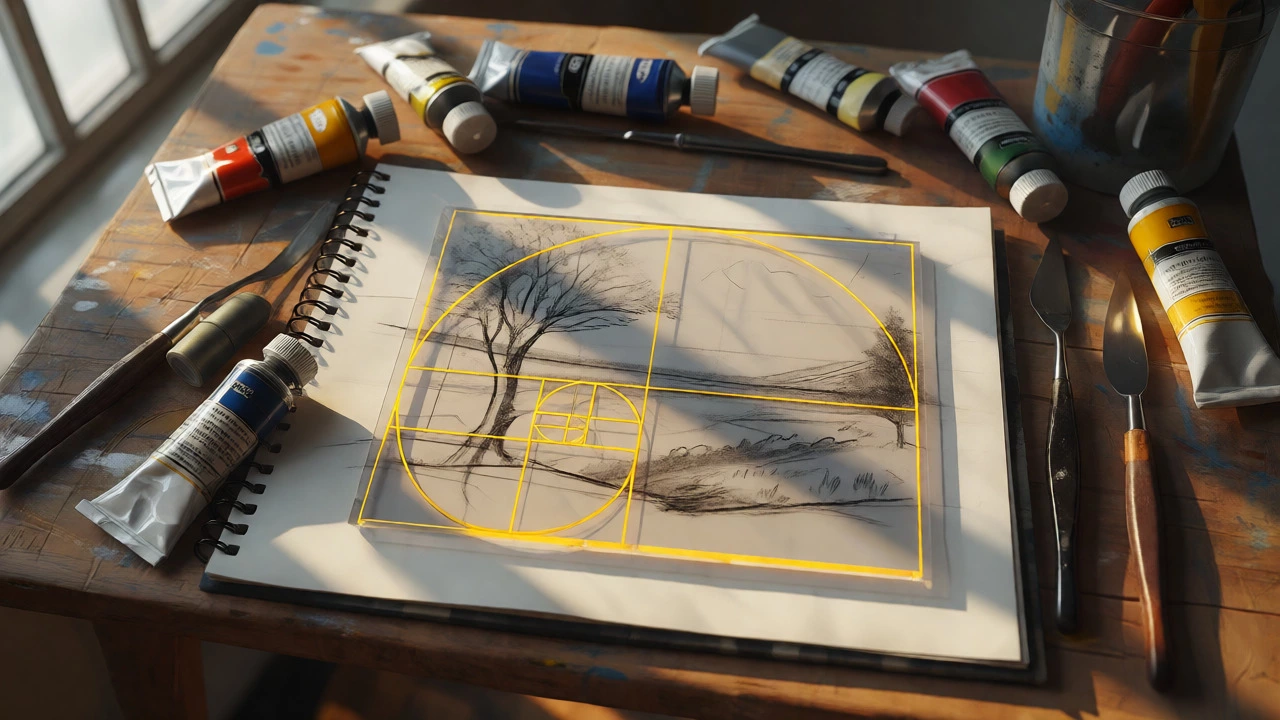
But the Golden Ratio goes deeper. If you want to be precise, you can draw a rectangle with sides in a 1:1.618 ratio. Then, you divide that rectangle into a square and a smaller rectangle that has the same proportions. Repeat this process, and you create a series of squares. Connecting the corners of these squares forms the Golden Spiral, also known as the Fibonacci spiral. This spiral shape is incredibly powerful in art because it mimics natural growth patterns.
When you’re sketching out a landscape, try aligning the horizon line or the path of a river with the curves of this spiral. In portraiture, you might position the eyes along the upper part of the spiral. It’s subtle. Viewers won’t see the math, but they will feel the harmony. Their eyes will travel smoothly from one element to another, rather than getting stuck or wandering off the edge of the canvas.
Fibonacci in Famous Works
Looking at history helps clarify the concept. Take Salvador Dalí’s The Sacrament of the Last Supper. Dalí explicitly used a dodecahedron structure based on the Golden Ratio to frame the scene. The result is a composition that feels both surreal and strangely stable. The figures are arranged in a way that draws the eye inward, creating a sense of divine order amidst chaos.
Another example is Piet Mondrian’s grid paintings. While he didn’t strictly use the Fibonacci sequence, his work explores the balance of rectangular spaces. Some analysts argue that his divisions reflect harmonic proportions similar to those found in Fibonacci-derived grids. Whether intentional or intuitive, the effect is clear: the paintings feel resolved and complete.
Even in contemporary digital art, these principles hold up. Designers use Fibonacci spirals to layout websites and apps because users intuitively know where to look. As an oil painter, you’re competing for attention in a visual world. Using proven compositional tools gives you an edge. It ensures that your hard work in blending oils and building layers doesn’t get lost in a cluttered arrangement.
Practical Steps for Oil Painters
Ready to try this in your studio? Here’s a simple workflow. Start with your underdrawing. Before you apply any paint, lightly mark out your Golden Rectangle. Most modern drawing tablets or even paper sketches allow you to overlay a template. If you’re working traditionally, you can calculate the dimensions quickly. For a standard 16x20 inch canvas, the Golden Ratio division would place a vertical line approximately 12.4 inches from the left edge (since 20 / 1.618 ≈ 12.36). Mark that spot.
- Step 1: Determine your canvas orientation. Landscape or portrait?
- Step 2: Calculate the primary division point using the 1.618 ratio.
- Step 3: Place your focal point near this intersection.
- Step 4: Use the spiral to guide secondary elements, ensuring they flow toward the focal point.
- Step 5: Check your negative space. Does it feel balanced? Adjust if necessary.
Don’t obsess over perfection. Art isn’t engineering. If your subject falls slightly off the exact pixel, it’s fine. The goal is directional guidance, not rigid confinement. Sometimes, breaking the rule intentionally can create drama. Maybe you place the subject dead center to convey stillness, then use the surrounding elements to follow the spiral. Experimentation is key.
Consider your color palette too. You can apply Fibonacci principles to value distribution. Assign values 1 through 5 to different areas of your painting. Ensure that the largest areas have the lowest contrast (values 1-2), while the highest contrast (value 5) is reserved for the smallest area-the focal point. This creates a hierarchy that keeps the viewer engaged.
Common Misconceptions
There’s a lot of hype around the Golden Ratio. Some people claim it’s in everything, from the Parthenon to Apple’s logo. Critics argue that this is confirmation bias-we see what we want to see. And they have a point. Not every masterpiece follows the Fibonacci sequence. Artists like Monet focused more on light and atmosphere than geometric precision.
So, don’t treat the Fibonacci sequence as a law. Treat it as a heuristic-a mental shortcut for decision-making. If you’re stuck on where to place a tree in a landscape, ask yourself: "Would it look better here, or shifted slightly to the right according to the spiral?" Often, the answer is yes. It provides a starting point for critique.
Also, remember that cultural context matters. Western art traditions heavily emphasize the Golden Ratio. Other traditions, like Japanese aesthetics, prioritize concepts like Ma (negative space) and asymmetry without necessarily referencing Phi. Understanding these differences broadens your toolkit. You can mix approaches, using Fibonacci for structural balance and Ma for atmospheric breathing room.
Beyond the Canvas: Digital Tools
If you’re comfortable with technology, there are apps and software plugins that overlay Fibonacci grids on your screen. Programs like Procreate or Adobe Photoshop allow you to import custom guides. You can save a Golden Spiral layer and toggle it on and off during your sketching phase. This speeds up the process significantly compared to manual calculation.
For traditionalists, masking tape is your friend. Cut strips of tape to mark your grid lines on the stretcher bars or the back of the canvas. They’re easy to remove and leave no residue. This physical reminder helps train your eye over time. Eventually, you won’t need the tape. You’ll just "feel" when the composition is off.
Practice makes perfect. Try recreating a classic painting using only the Fibonacci grid to plan your composition. Then, compare it to the original. Did you miss anything? Did the grid help you understand why the artist made certain choices? This kind of analytical practice builds intuition faster than random experimentation.
Frequently Asked Questions
Is the Fibonacci sequence the same as the Golden Ratio?
Not exactly, but they are closely linked. The Fibonacci sequence is the list of numbers (0, 1, 1, 2, 3...). The Golden Ratio is the mathematical constant (approx. 1.618) that emerges when you divide a Fibonacci number by the one before it. Artists use the sequence to derive the ratio and the spiral shape.
Do I need to measure my canvas precisely to use this technique?
Precision helps, but it’s not mandatory. Approximations work well. Many artists use the Rule of Thirds, which is close enough for most purposes. If you want accuracy, use a ruler and calculator once to set up your initial marks, then rely on your eye for adjustments.
Can I use the Fibonacci spiral for abstract paintings?
Absolutely. Abstract art relies heavily on visual flow and balance. The spiral can guide the movement of shapes and colors, creating a sense of rhythm and progression that viewers subconsciously appreciate.
Did all famous artists use the Fibonacci sequence?
No. While many Renaissance artists studied geometry, not all applied the Golden Ratio consciously. Some achieved harmony through instinct and experience. The Fibonacci sequence is a tool, not a requirement for great art.
How does the Fibonacci sequence affect color choice?
It primarily affects composition, but you can apply it to color weight. For instance, allocate 62% of your canvas to neutral tones and 38% to vibrant accents, roughly mirroring the inverse of the Golden Ratio proportions.