Who is the Father of Modern Art?
The title "Father of Modern Art" is contested. This tool helps you understand why by comparing the three main candidates. Choose the description that best matches your understanding of what makes art "modern," then see who historians credit for that specific revolution.
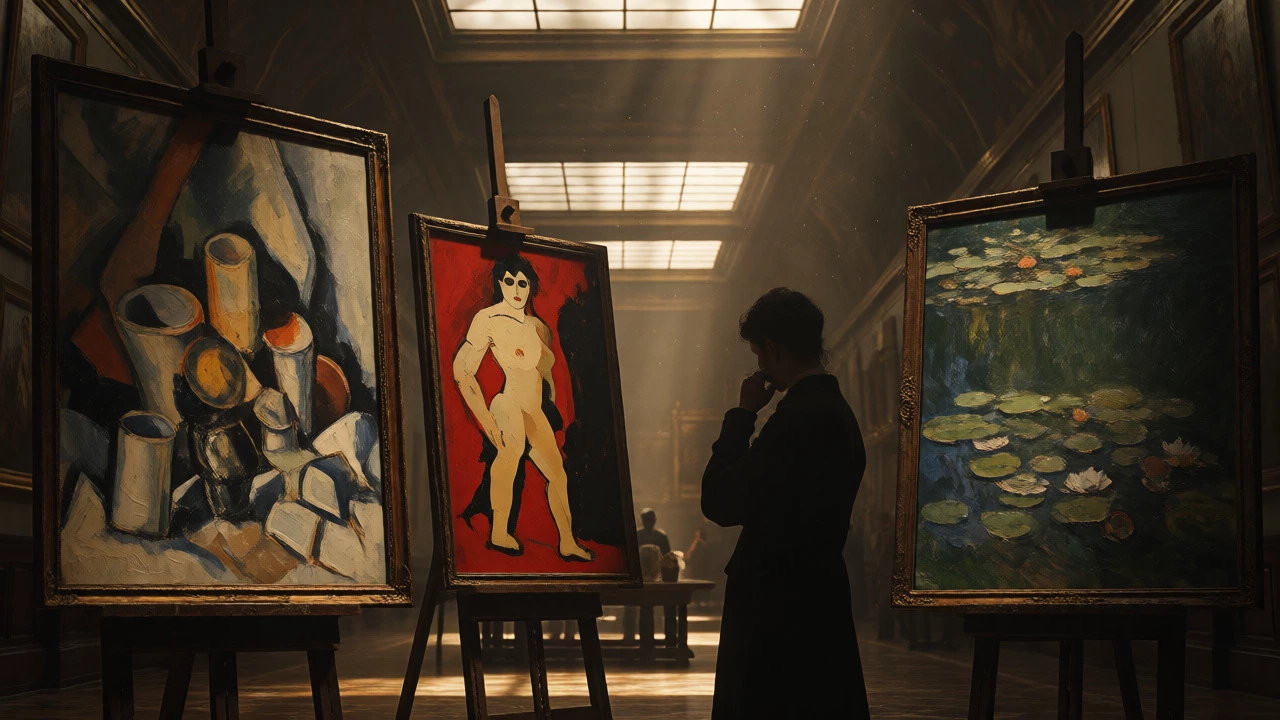
Paul Cézanne
Focuses on Structure & Form. Broke objects into geometric shapes (cylinders, spheres, cones). Bridged Impressionism and Cubism.
Édouard Manet
Focuses on Subject & Attitude. Challenged academic rules with contemporary, raw subjects like *Olympia*. Rejected idealized beauty.
Claude Monet
Focuses on Light & Perception. Captured fleeting moments and light effects (*en plein air*). Liberated color from local reality.
Select an artist and a definition above to see the historical verdict.
Quick Reference Guide
| Artist | Key Innovation | Legacy |
|---|---|---|
| Cézanne | Geometric simplification | Paved way for Cubism (Picasso) |
| Manet | Contemporary subject matter | Freed art from Academic approval |
| Monet | Light and color perception | Liberated the palette; precursor to abstraction |
You walk into a museum, stand before a canvas where colors clash and shapes defy logic, and you wonder: who started this chaos? The title "Father of Modern Art" isn't handed out like a diploma. It’s a contested throne. If you ask ten art historians, you might get three different answers. Why? Because modern art wasn't born in a single moment. It was a slow burn, a series of rebellions against the rigid rules of the past.
Most people point to Paul Cézanne. But others argue for Édouard Manet as the true instigator, or even Claude Monet as the visual pioneer. So, who really deserves the crown? Let's break down the case for each candidate, because understanding who started it helps you understand what you're actually looking at when you stare at a Picasso or a Pollock.
The Case for Paul Cézanne: The Bridge to Cubism
If you had to pick one name that appears on every shortlist, it would be Paul Cézanne. He didn't just paint differently; he fundamentally changed how we see form. Before Cézanne, painting was largely about illusion-making a flat surface look like a window into a realistic world. Cézanne said, "No, let's acknowledge the flatness." He broke objects down into geometric shapes: cylinders, spheres, and cones.
Pablo Picasso famously called Cézanne "the only master." That’s high praise from the guy who invented Cubism. When you look at a Cézanne still life, you don't see perfect perspective. You see multiple viewpoints simultaneously. This idea-that an object can be seen from above and below at the same time-is the direct ancestor of 20th-century abstraction. Without Cézanne, there is no Cubism. No Cubism means no abstract expressionism. In the lineage of modern art, Cézanne is the grandfather everyone respects but few want to emulate directly because his work requires intense study.
| Attribute | Detail |
|---|---|
| Key Innovation | Geometric simplification of nature |
| Influence On | Cubism, Abstract Art, Matisse |
| Famous Quote | "Treat nature by the cylinder, the sphere, the cone" |
| Era | Late 19th Century (Post-Impressionism) |
Édouard Manet: The Rebel Who Broke the Rules
While Cézanne changed how we see form, Édouard Manet changed what we accept as subject matter. Manet is often considered the first truly modern artist not because of his brushstrokes, but because of his attitude. He refused to play by the Academy's rules.
Take his painting *Olympia*. In 1865, depicting a nude woman as a confident prostitute rather than a mythological goddess caused a scandal. The Academy wanted idealized beauty; Manet gave them raw reality. He used flat areas of color and harsh lighting, rejecting the smooth blending techniques of his predecessors. This wasn't just a style choice; it was a declaration of independence. Manet proved that art could be about contemporary life, warts and all, without needing historical or religious justification.
Many historians argue Manet is the real father because he initiated the break with tradition. Cézanne refined it; Manet shattered it. If modern art is defined by its rejection of academic standards, Manet fired the first shot.
Claude Monet and the Impressionist Shift
You can't talk about modern art without mentioning Claude Monet. As the leader of the Impressionists, Monet shifted the focus from what things are to how light hits them. His famous series paintings, like the Rouen Cathedral or Water Lilies, show that reality is fleeting.
Monet’s contribution was technical and philosophical. By painting outdoors (*en plein air*), he captured transient moments. This challenged the studio-bound perfection of the Salon painters. However, while Monet liberated color and light, he remained tethered to representation. You always know what you're looking at in a Monet. In later modern movements, like Dada or Surrealism, the link to reality was severed completely. For this reason, many experts view Monet as a crucial precursor-a great-uncle, if you will-rather than the direct father of the radical abstractions that followed.
Why There Is No Single Answer
The debate persists because "modern art" isn't a monolith. It’s a collection of revolutions.
- Manet revolutionized the subject and the social role of the artist.
- Monet revolutionized the perception of light and color.
- Cézanne revolutionized the structure and form.
If you define modern art as the move away from realism toward abstraction, Cézanne wins. If you define it as the move away from academic approval toward artistic freedom, Manet wins. If you define it as the capture of subjective experience, Monet has a strong claim.
Consider the timeline. Manet died in 1883. Cézanne worked until 1906. Monet lived until 1926. The momentum shifted from Manet’s shock value to Monet’s sensory exploration, and finally to Cézanne’s structural analysis. Each built on the other. Manet freed the subject; Monet freed the palette; Cézanne freed the form.
Other Contenders Worth Knowing
While the big three dominate the conversation, other names pop up depending on your definition of "modern."
Vincent van Gogh brought emotional intensity to the forefront. His swirling skies and vibrant yellows weren't just pretty; they were psychological expressions. This paved the way for Expressionism. Similarly, Henri de Toulouse-Lautrec merged fine art with commercial poster design, blurring the lines between high culture and popular media-a very modern concept.
Some critics also mention Gustave Courbet. A Realist, Courbet insisted on painting only what he could see, rejecting Romantic idealism. His manifesto-like approach influenced Manet directly. If Manet is the father, Courbet might be the grandfather who taught him to walk.
How to Spot the "Modern" Influence Today
So why does this matter to you? When you visit a gallery today, knowing these roots changes your experience. If you see fragmented forms, think Cézanne. If you see bold, unapologetic subjects challenging social norms, think Manet. If you see a focus on atmosphere over detail, think Monet.
Modern art isn't just about weird shapes. It's about a specific mindset: questioning authority, experimenting with materials, and prioritizing individual vision over collective tradition. These artists didn't set out to be "fathers." They set out to solve problems. Cézanne struggled with how to make a painting feel solid yet alive. Manet struggled with how to be relevant in a changing society. Their solutions became the foundation for everything that followed.
Next time someone asks you who the father of modern art is, don't just give one name. Explain the nuance. Tell them it’s a family tree, not a solo act. But if forced to choose the one whose DNA is most visible in abstract art, go with Cézanne. His fingerprints are everywhere.
Why is Paul Cézanne often called the father of modern art?
Cézanne is credited because he bridged the gap between late 19th-century Impressionism and early 20th-century Cubism. By breaking natural forms down into geometric shapes like cylinders and spheres, he introduced a new way of seeing that directly influenced Pablo Picasso and Georges Braque.
Was Édouard Manet an Impressionist?
Technically, no. While Manet associated closely with the Impressionists and influenced them heavily, he never exhibited with them. He preferred to submit work to the official Salon and maintained a more traditional studio practice compared to the plein-air methods of Monet and Renoir.
What defines "modern art" versus "contemporary art"?
Modern art generally refers to works created from the 1860s through the 1970s. Contemporary art refers to art produced from the mid-1970s to the present day. The distinction is primarily chronological, though modern art focuses more on formal innovation and medium-specificity, while contemporary art often engages with global issues and digital media.
Did Vincent van Gogh influence modern art?
Yes, significantly. Van Gogh's use of color and expressive brushwork laid the groundwork for Fauvism and German Expressionism. While he didn't abandon representation entirely, his emphasis on emotional truth over optical accuracy was a key tenet of modernist philosophy.
Is there a female "mother" of modern art?
Berthe Morisot is often cited as a key figure, being a central member of the Impressionists. Mary Cassatt also played a vital role in bringing Impressionism to America. However, the term "father" is historically tied to the patriarchal canon of art history, which often overlooked women despite their significant contributions to the movement's development.