Jul 21, 2025
Highest Paid Digital Artist: The Record-Breaking Earnings of Beeple and His Rivals
When you paint a realistic landscape painting, a detailed, true-to-life depiction of natural scenery that emphasizes texture, light, and spatial depth. Also known as photorealistic landscape art, it’s not just about copying what you see—it’s about understanding how light falls on hills, how trees cast shadows, and how distance changes color and detail. This style demands patience, observation, and a solid grasp of how the eye perceives space.
Behind every convincing landscape is a structure built on three key layers: foreground, the closest area to the viewer, often filled with texture and fine detail, middle ground, where the main subject—like a field, lake, or path—lives, and background, the farthest elements, softened by atmospheric perspective and cooler tones. These aren’t just zones—they’re tools. The way you handle each one determines whether your painting feels like a window into the world or just a flat picture.
Tools matter too. Many artists stick with oil painting, a slow-drying medium that allows for blending and refining over days because it gives them time to adjust shadows, glaze colors, and build up realistic surfaces. But you don’t need fancy brushes or expensive canvases to start. What you do need is to study real light—how it hits a rock at noon versus sunset, how mist softens distant trees, how grass doesn’t all look the same shade of green. Realism isn’t about perfection—it’s about truth.
Color choices make or break it. A muddy sky or flat grass will kill the illusion. Learn how to mix earth tones that feel alive, not dull. Notice how shadows aren’t just gray—they carry hints of blue, purple, or even green from surrounding plants. And don’t forget composition. The rule of thirds isn’t just for portraits—it helps you place horizons, paths, and focal points so the viewer’s eye moves naturally through the scene. A winding river, a lone tree on a hill, a break in the clouds—these aren’t decorations. They’re anchors.
Some artists add people to landscapes—not as the focus, but to give scale and story. A single figure walking along a shore makes the mountains feel bigger. A boat on a lake tells you there’s water deep enough to sail. These small choices turn a pretty scene into something that feels lived-in.
And if you’ve ever wondered why some landscapes look flat while others pull you in, it’s rarely about skill alone. It’s about intention. Realistic landscape painting is about slowing down, seeing deeply, and translating what you feel as much as what you see. It’s not about copying a photo. It’s about making the viewer feel the wind, smell the pine, hear the quiet.
Below, you’ll find guides that break down exactly how to build depth, choose the right paints, avoid common mistakes, and turn your sketches into finished pieces that feel real—not just accurate, but alive.
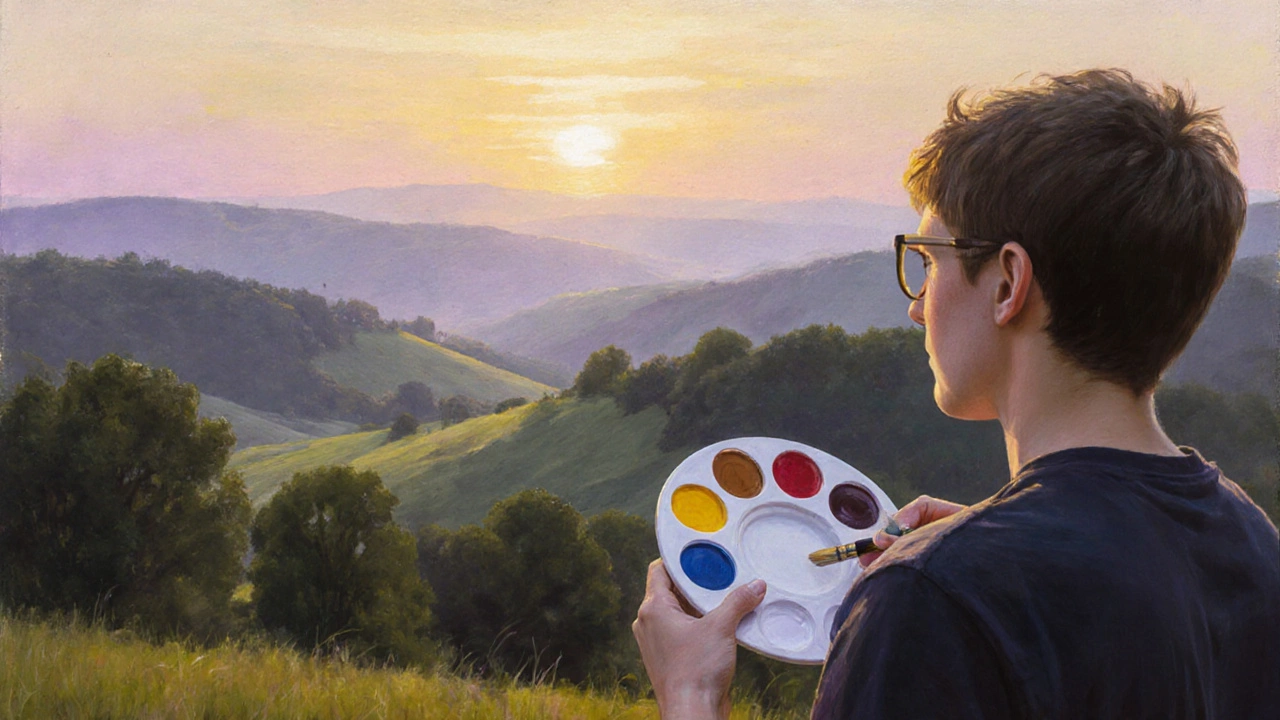
Learn how to paint realistic landscapes by focusing on light, value, and atmospheric perspective instead of details. Step-by-step techniques for beginners using oil or acrylics.