Watercolor Paper Cost Calculator
Compare stretching paper versus watercolor blocks or mounted boards for your project size and paper weight
Results
Watercolor paper buckles. It warps. It curls up at the edges like a dried leaf. If you’ve ever painted with loose sheets of watercolor paper, you’ve probably dealt with this. Stretching paper is the traditional fix - soaking the paper, taping it down, letting it dry flat. But it’s messy, time-consuming, and sometimes still doesn’t work perfectly. So what’s the alternative?
Watercolor Blocks: The Plug-and-Play Solution
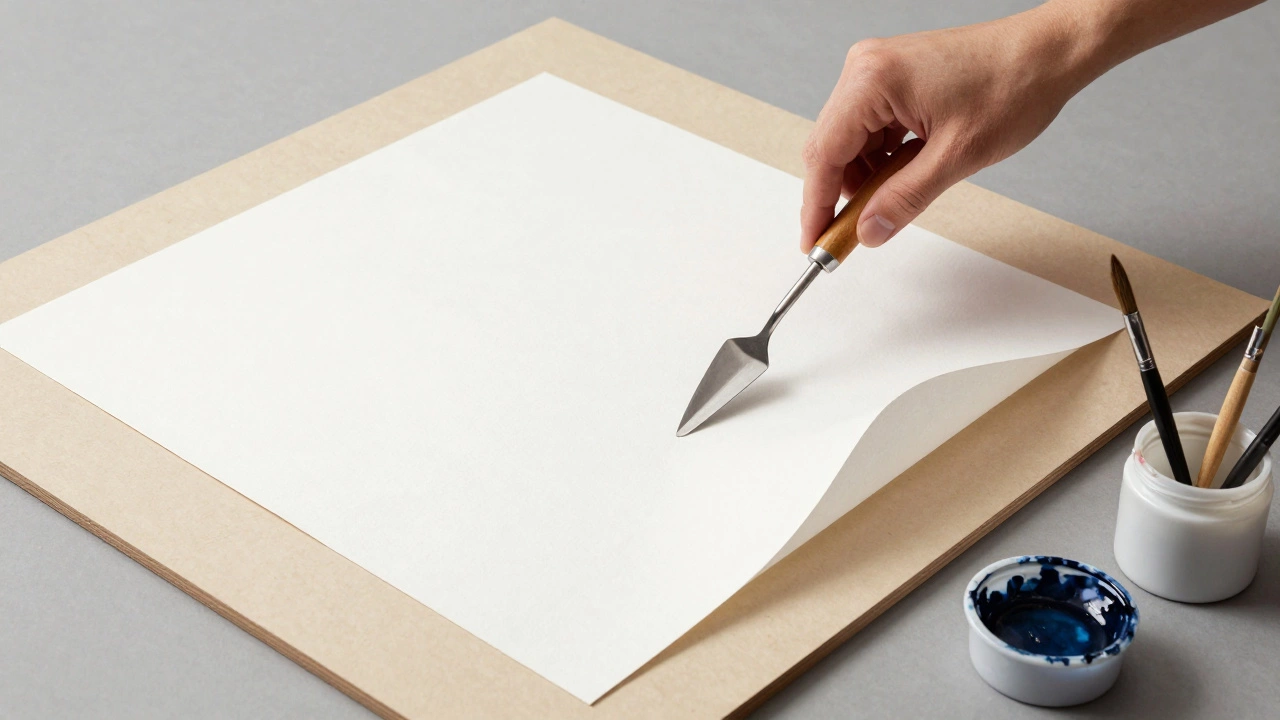
Watercolor blocks are sheets of paper glued on all four sides to a rigid backing board. You paint directly on them. When you’re done, you use a palette knife to slice along the edge and peel off your finished piece. No soaking. No tape. No waiting for it to dry flat. The glue holds the paper tight through multiple washes, even with heavy water use.
Brands like Arches, Canson, and Strathmore make these blocks in standard sizes - 9x12 inches, 14x18 inches, 22x30 inches. The paper weight ranges from 140 lb (300 gsm) to 300 lb (640 gsm). The heavier the paper, the less likely it is to buckle, even without stretching. A 300 lb block can handle wet-on-wet techniques without a single ripple.
Artists who paint outdoors, travel often, or work quickly love blocks. There’s no prep. No cleanup. Just open the block, paint, and go. One artist in Portland told me she uses a 9x12 Arches block every weekend for plein air work. She’s painted over 200 pieces this way in the last year. None warped.
Watercolor Boards: A Sturdy Base for Heavy Work
If you want something even more rigid than a block, try mounting your paper to a board. Gatorboard, foam core, or even thin plywood works. Cut the board to your desired size, then use a spray adhesive or a thin layer of PVA glue to stick your paper flat. Let it dry under a light weight for a few hours.
This method is perfect for large paintings or pieces that need to be framed without glass. The board adds stability, prevents warping permanently, and gives your painting a professional, gallery-ready feel. You can paint directly on the mounted surface, and once it’s dry, you can even sand the edges smooth or paint the borders.
One watercolorist in Chicago uses 1/4-inch Gatorboard for her exhibition pieces. She glues 300 lb Arches paper to it, then paints with multiple glazes. She says the board doesn’t flex, even when she loads her brush with pure pigment and water. The result? Crisp edges, no buckling, and a surface that holds up under varnish.
Pre-Stretched Paper: Ready-Made and Reliable
Some companies now sell paper that’s already stretched and mounted on stretchers - like canvas, but for watercolor. These are less common, but they exist. Brands like Art Spectrum offer stretched watercolor panels where the paper is glued to a wood frame and held taut with staples or clips.
They’re ideal for artists who want the texture and absorbency of real watercolor paper but need something that won’t move during painting. These panels are heavier, so they’re not great for travel, but they’re excellent for studio work. You can paint over them multiple times, let them dry upside down, or even hang them on the wall while wet - no risk of curling.
Why Stretching Isn’t Always the Answer
Stretching paper sounds simple: soak, tape, dry. But in practice, it’s full of pitfalls. If you don’t soak long enough, the paper still buckles. If you soak too long, the sizing breaks down and colors bleed uncontrollably. If the tape isn’t tight, the paper wrinkles. If the room is humid, it takes forever to dry.
And then there’s the waste. You cut your paper to size, soak it, tape it, wait 12-24 hours, then remove the tape and cut the edges again. That’s three cuts per sheet. If you’re working on a series, that’s a lot of paper lost to trimming.
Plus, stretching doesn’t guarantee perfection. Even after all that work, some papers still warp slightly, especially if they’re lower quality or if you use a lot of water in one area. It’s a band-aid solution, not a fix.
When to Stick With Stretching
There are still reasons to stretch. If you’re using very thin paper - 90 lb or less - and you’re doing large washes, stretching gives you more control. If you’re working on a custom size that doesn’t come in blocks or boards, stretching is your only option. And if you’re learning, it’s good to understand how paper behaves under tension.
But if you’re beyond the beginner stage, and you’re tired of the mess and waiting, there are better ways. Most professionals switch to blocks or mounted boards once they find them. It’s not about giving up stretching - it’s about upgrading your process.
Cost Comparison: Blocks vs. Stretching
Let’s say you use 140 lb cold press paper. A single sheet (22x30 inches) costs about $5.50. You need to soak it, tape it, wait, then trim the edges - and you lose about 2 inches on each side. That’s 18x26 inches of usable space. You’ve spent $5.50 and lost 25% of your paper.
A 9x12 inch Arches block (140 lb) costs $18. It has 12 sheets. That’s $1.50 per sheet. You get the full size of each sheet, no trimming, no waste. And you can paint right away.
For 300 lb paper, the savings are even bigger. A single 22x30 inch sheet costs $15. A 9x12 inch 300 lb block with 12 sheets costs $45 - that’s $3.75 per sheet. You’re paying more per sheet, but you’re getting perfect results every time, with zero prep.
Pro Tips for Using Alternatives
- For blocks: Use a light touch with your brush. The glue is strong, but if you scrub too hard, you can lift the paper slightly. Use a soft brush, not a stiff one.
- For mounted boards: Use PVA glue, not Mod Podge or white craft glue. PVA dries clear and flexible, so it won’t crack when the paper expands.
- Always let mounted paper dry under a flat weight - even a stack of books - for at least 6 hours. This ensures full adhesion.
- Don’t use spray adhesive on delicate paper. It can cause spotting or uneven adhesion. Brush-on glue gives you more control.
- If you’re using a board, seal the edges with acrylic gesso or clear acrylic medium. It protects the board from moisture and looks cleaner when framed.
What About Watercolor Canvas?
Some artists turn to watercolor canvas - fabric treated with a sizing that lets watercolor adhere. But it’s not the same. The texture is different. The absorption is faster. The colors look duller. It’s great for mixed media or bold, expressive work, but it doesn’t give you the delicate blooms and granulation you get on real paper.
It’s not an alternative to stretching. It’s a different medium.
Final Thoughts
Stretching watercolor paper isn’t broken - it’s just outdated. There are better, faster, cleaner ways to keep your paper flat. Watercolor blocks are the most popular alternative. They’re ready to use, affordable over time, and foolproof. Mounted boards are the upgrade for serious work. Both eliminate the guesswork, the waiting, and the frustration.
If you’re still stretching paper because you think it’s the only way, you’re not being traditional - you’re being inefficient. Try a block. Try mounting. You might never go back.
Can I use watercolor blocks for large paintings?
Yes, but standard blocks are usually limited to 22x30 inches. For larger work, mount your own paper onto Gatorboard or foam core. You can buy large sheets of board and cut them to size. This gives you the same flat surface without the size restrictions of pre-made blocks.
Do watercolor blocks warp over time?
No, not if they’re made properly. The glue holds the paper tightly to the backing, and the backing is rigid. Once the painting is dry, the paper stays flat. Even in humid environments, the block won’t buckle. This is why galleries and collectors prefer pieces done on blocks or mounted boards.
Is mounting paper to a board permanent?
Yes. Once you glue the paper to a board, you can’t remove it without damaging the paper. That’s why it’s best for finished pieces you plan to frame or display. If you want to reuse the paper, stick with blocks or stretch it temporarily.
Can I paint on both sides of a watercolor block?
No. The paper is glued on one side only. You can only paint on the top surface. Once you finish a sheet, you peel it off and move to the next. Some artists use the back of the board as a sketch surface, but never paint watercolor on the underside.
What’s the best paper weight for alternatives to stretching?
For blocks and mounted boards, use 300 lb (640 gsm) paper. It’s thick enough to resist warping without any prep. 140 lb works too, but only if you’re using light washes. Heavy washes, wet-on-wet techniques, or scrubbing require the extra thickness of 300 lb.